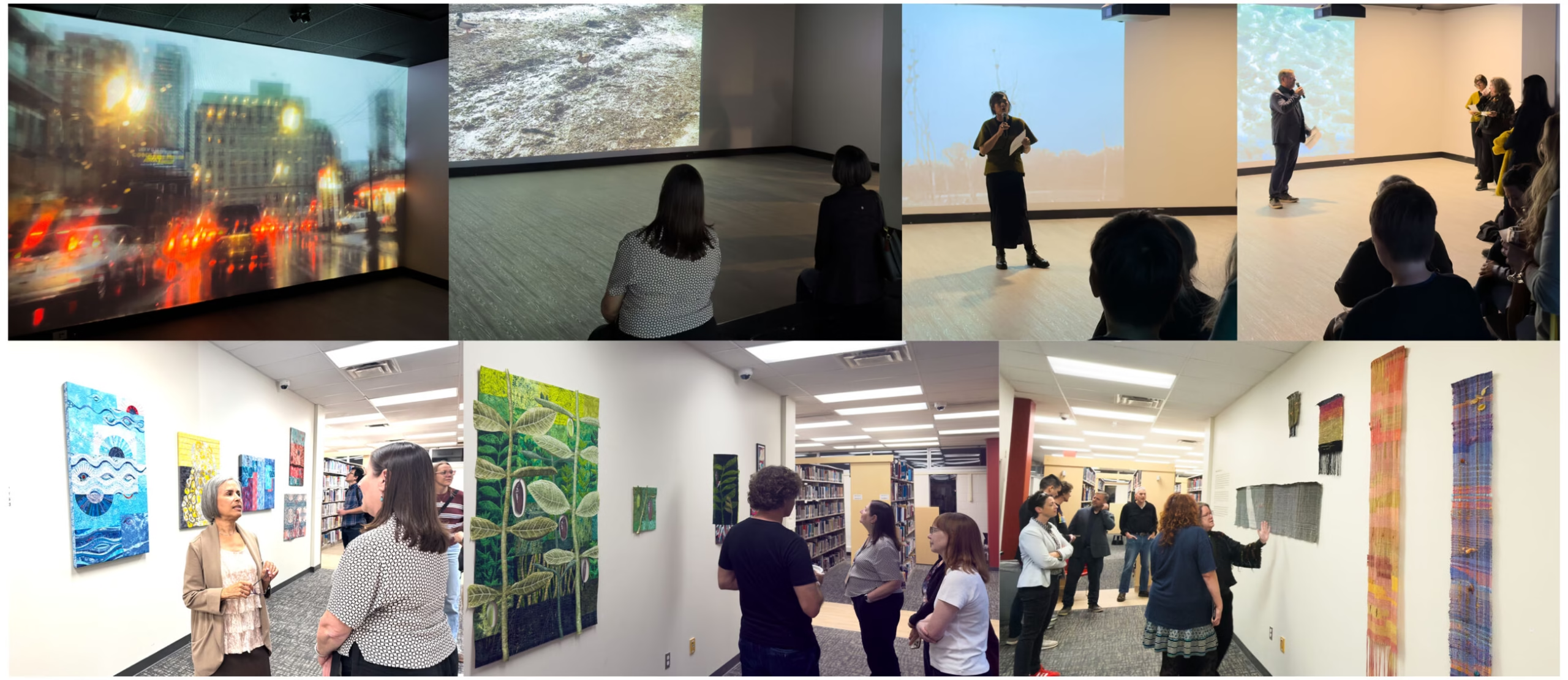
On Sept. 8, 2026, the Robert Langen Art Gallery (RLAG) opened its Fall 2026 exhibition, Traces & Echoes: Between Places, a collaborative installation by artists Michelle Breslin and Barbara Greczny.
Traces & Echoes: Between Places explores the enduring connections between landscape, memory, loss and human experience. While Breslin and Greczny have collaborated many times over the years, this is their first dedicated exhibition showcasing their work together. The exhibition features two immersive and contemplative video installations that are independent, yet intersect in many places, with a soundscape that allows the viewer to anchor and navigate their emotions.
“An interesting moment was the conversation that started this project,” Greczny said. “We hadn’t spoken for quite some time, and when we caught up, we discovered that we were both photographing trees, nature, and landscapes independently. That shared interest became the starting point for the exhibition.”
“My feeling was that our memories were disappearing at the moment they appeared, and Barbara was left with the remnants of a happier time in her relationship with her brother, and her young family,” Breslin said. “She was gathering these fragments and piecing them together, as a way of understanding and constructing memory.”
Breslin, who also designed the soundscape for the exhibition, added, “The soundscape has movement and transitions that flow in and out, taking you to different spaces. It provides moments to rest and other moments of intensity. The videos give a place to arrive and then to pause and eventually continue the journey, and the music and video work together in that way, always arriving and departing at differing points throughout the exhibit.”
One aspect of the exhibition that stands out is the passage of time. “The footage preserves a specific moment in time, but now I’m looking at it from a different point in my life,” Greczny said. “What I remember, who I associate a place with, and how I feel about that experience has changed. To me, that feels connected to memory. We return to an image of the past, but we experience it through who we are in the present.”
Speaking about the temporal aspect of the work, Suzanne Luke, the curator of RLAG, added that each time someone visits the gallery, they have a different experience because the exhibition is in constant flux.
Alongside this, the gallery also opened its annual LIFT series, Take a Second Look, a dynamic new fibre-based exhibition featuring the work of three acclaimed Waterloo Region artists: June DaSilva, Sally Gray and Heather A. Hager.
“Take a Second Look brings together three distinct approaches to materiality, process, and form. The exhibition features abstracted organic patterns embellished with beads and other precious materials, thoughtful handwoven compositions, and quilted sculptural forms that explore ecological concerns,” an RLAG press release stated on Sept. 22, 2026.
The LIFT series aims to showcase various disciplines from local artists to capture the diversity of the local arts landscape. Luke added that the gallery had been eager to feature fibre arts for a long time, making this exhibition a long-awaited milestone.
Having learned how to sew as a child, June DaSilva’s practice began when she saw an exhibition about 20 years ago. She said, “It just blew my mind that you could do that with fabric and thread and put together art that looked amazing, because I had never seen anything like it before.” Her work involves significant experimentation, where a starting point with a material or technique slowly evolves into the final piece. In this exhibition, DaSilva’s work explores the relationship between actual and perceived texture. She explained, “When I stitch layers of cloth together, the peaks and valleys that are formed contrast with patterns in the fabric itself.”
Sally Gray, who also picked up fibre arts as a child, said, “My mother taught me how to sew, knit, and embroider at an early age. I grew up with her always having knitting in her hands in the evenings, making our clothes.” Gray’s work employs a variety of techniques and fosters a multidisciplinary approach. Speaking about her work in the exhibition, she said, “The collection invites viewers to experience weaving as both a visual language and a performative process, revealing how rhythm, gesture, and material come together in the making of each piece.”
Lastly, Heather A. Hager is a Waterloo-based textile artist working in mixed-media, non-traditional art quilts. Hager holds a PhD in ecology, which deeply influences her work. She said, “I love nature and think it’s fascinating, but we get to spend so little time in it. And I mean areas [that] aren’t overly landscaped and managed. Once you start walking through a ‘wild’ or ‘natural’ area regularly… and observe, you can really get to know it. I’m also concerned about what we humans are doing to the Earth, and these topics influence a lot of my art.” The work featured in this exhibition began during the pandemic and was influenced by the widely publicized mass emergence of the 17-year cicada in the northeastern U.S., as well as her explorations incorporating paper into her art quilts.
All of their works interact with one another in compelling ways. DaSilva pointed out that while each of them employs different practices, they overlap through their materiality and how humans perceive that. Gray added that while their processes are traditionally considered utilitarian, they use them to express themselves, explore ideas, and create beauty. Hager noted that the materiality of the work is a unifying element—specifically the tactility and textures achieved when working with fabric and fibre.
Traces & Echoes: Between Places runs until Nov. 28, 2026, at the RLAG in the Laurier Library, while the LIFT series is on until summer 2027. The opening reception for the exhibition took place on Oct. 7, 2026, drawing a warm response from the community. More information about the exhibitions can be found at RLAG’s website.
Contributed photos by Santosh Chandrasekar and Robert Langen Art Gallery