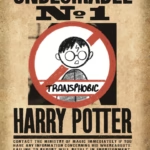
My first experience with Harry Potter was receiving a boxed set from my aunt for Christmas as a child. I went through all seven books in a matter of weeks, and became obsessed with hippogriffs, quidditch and portkeys. The appeal of the series for me was the themes of good overcoming evil and love conquering all. Love can stop death, or even bring someone back from it. Because of Harry Potter, I credit some of my love for fantasy to J.K. Rowling. But that’s where my praise for Rowling ends.
Rowling rose to fame in the late 90’s after the publication of the first Harry Potter novel. She faced domestic abuse and extreme poverty, but because of the success of her books, she became a self-made success story. Her story was empowering and gave hope to other creatives looking to make it big in their industries – Rowling became a role model.
And then she started tweeting.
This began when she, unprompted, began to spew anti-trans rhetoric online, going to bat for Maya Forstater, who was functionally fired because of her transphobic statements. In defence of Forstater, Rowling tweeted, “Dress however you please. Call yourself whatever you like. Sleep with any consenting adult who’ll have you. Live your best life in peace and security. But force women out of their jobs for stating that sex is real?”.
Rowling has only become more outspoken in her transphobia. In 2020, she said, “When you throw open the doors of bathrooms and changing rooms to any man who believes or feels he’s a woman…then you open the door to any and all men who wish to come inside”. Her comments are filled with hatred and an ignorance that is difficult to reconcile with the lessons her books teach.
As the world learned more about Rowling’s bigotry, many, including myself, started to reconsider if the books they’d loved as children were actually as wholesome as they’d thought. One glaring issue with Rowling’s work is her lack of consideration when writing POC. Names like Cho Chang and Kingsley Shacklebolt have led many to question whether she gave the same thought to these characters that she gave to the rest of her wizarding world.. or, worse, were these names a joke?
Rowling has also faced significant criticism for her attempts to woke-wash her novels. After being prompted by fans, she started retroactively sorting characters like Albus Dumbledore and Hermione Granger into more oppressed categories, leading some to ask, why not write marginalized characters in the first place?
Why rewrite her own work now? Why try to please her audience? Why keep half-heartedly attempting to maintain a woke persona while actively tweeting hatred online? Yes, Rowling created Harry Potter and the wizarding world, but I don’t believe we need her permission to decide what readers can make out of it.
The Mortal Instruments series, one of my favourite YA fantasy series for its queer and POC representation, was written by Harry Potter fanfiction writer, Cassandra Clare. Clare has written numerous Harry Potter stories and fans have speculated that her fanfiction may have inspired The Mortal Instruments. Without Harry Potter, these books may not exist. Or take the Marauders sub-fandom: fans have expanded on canon, focusing on Harry Potter’s parents and their friends through queer fanfiction and other fan-made media. In the confines of such a heteronormative story, the Marauders fandom defies canon and produces some of the gayest media to exist. Marauders builds off of Rowling’s work, but ultimately takes its own form in a way that highlights queer and POC characters in a way that fans deserve.
When I think of the Harry Potter books now, I can’t pretend that Rowling’s views and biases don’t show themselves in her work. However, that’s the beauty of fandom, I don’t have to read Rowling’s work. The wizarding world isn’t just confined to what Rowling creates. Readers can take something created by one person and turn it into something entirely their own.
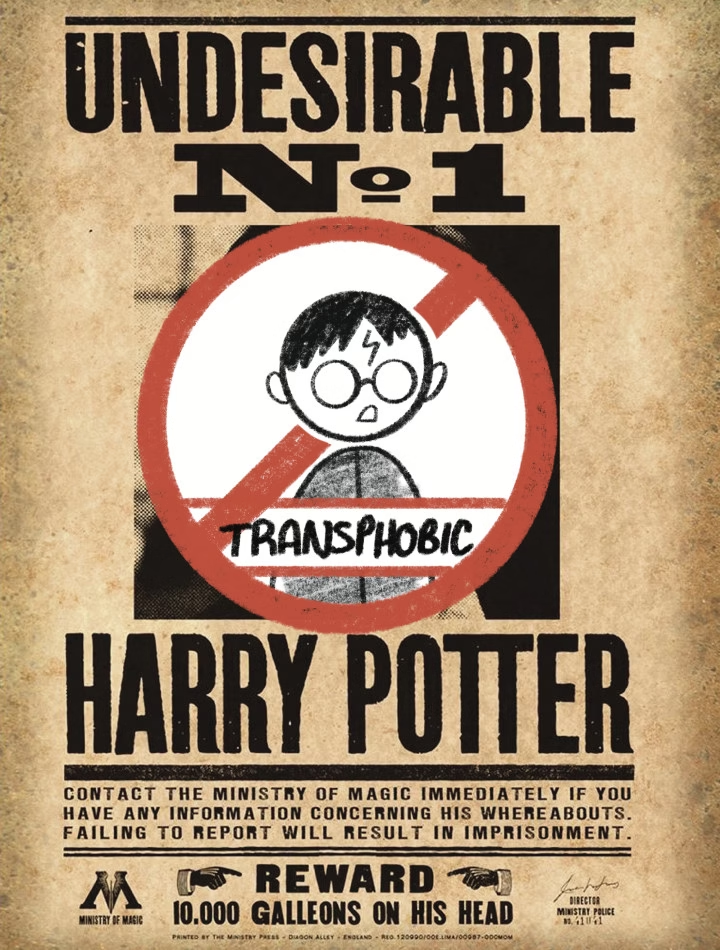
Graphic by Anna Koehler