When the United States and Israel began striking Iran in late February 2026, there was an optimistic expectation that this would be a short-lived crisis that would not totally disrupt the world economy. Yet half a year later, the conflict continues, and the closure of the Strait of Hormuz has severed 14 per cent of global oil output from the world’s supply. For comparison, Russia’s 2022 invasion of Ukraine cut off only one per cent of global oil. This begs the question: how have international oil prices remained stable despite the 2.5 billion barrels cut off since February?
The simplest and most reliable solution was for the world’s major economies, namely the U.S., Japan, and the European members of the Organization for Economic Co-operation and Development (OECD), to release their strategic stockpiles into the global market. Accordingly, less than two weeks after the strikes began, the International Energy Agency (IEA) announced a historic release of 400 million barrels of oil, mostly from these nations’ reserves. Yet this record-breaking volume could cover only about one month of the Strait’s closure, meaning the relative stability of oil prices cannot be due solely to this IEA release.
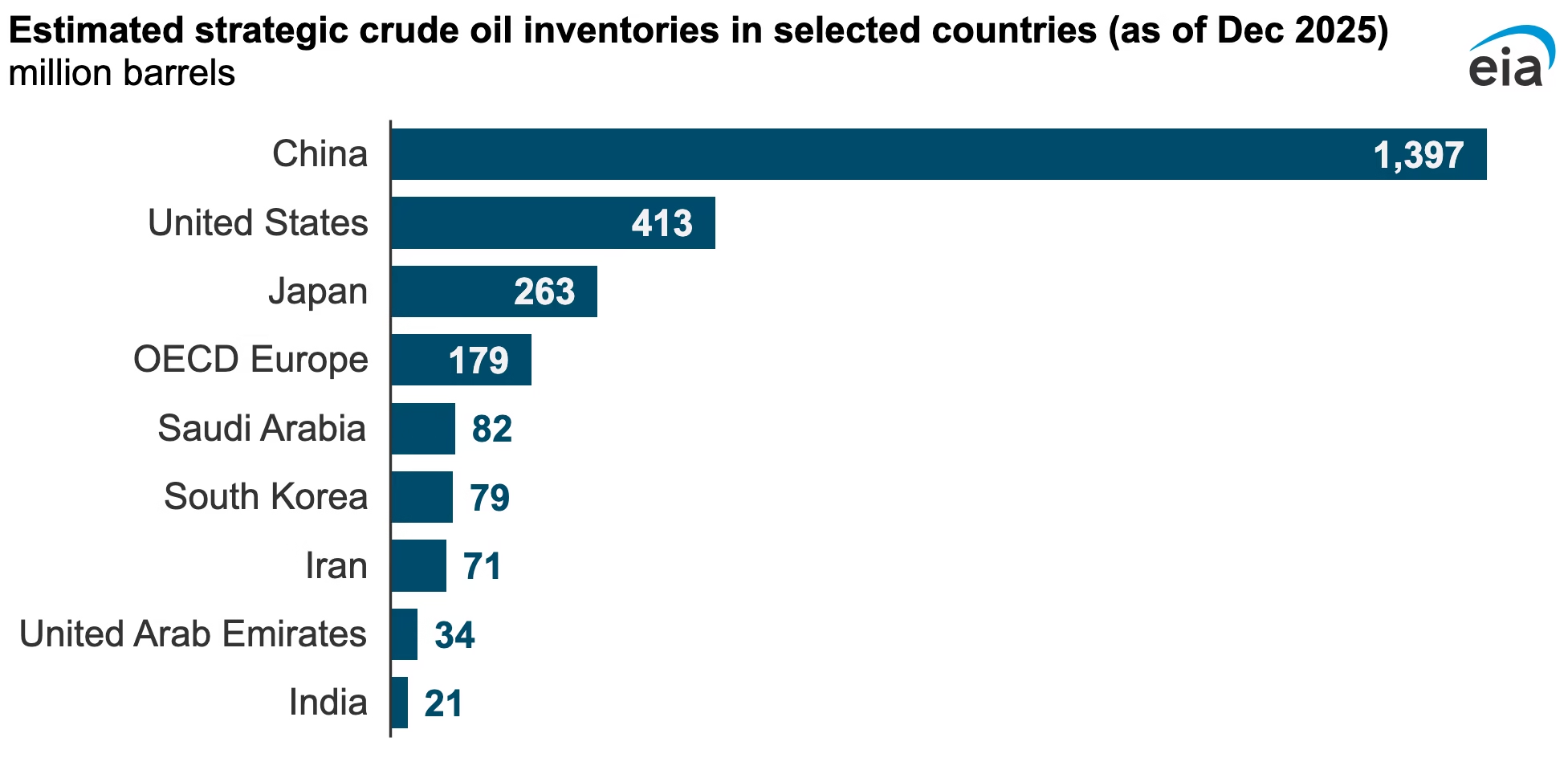
China’s massive, secret intervention explains this stability. The U.S. Energy Information Administration (USEIA) estimated in December 2025 that the OECD Europe held 179 million barrels of oil, Japan held 263 million, and the U.S. held 413 million. While the exact size of China’s oil reserves remains a state secret, the USEIA approximated that China stockpiled 1.4 billion barrels at the start of the war, more than every other country combined, with the true scale potentially much larger. Drawing from this colossal supply, China has been quietly pumping millions of barrels of oil daily into global markets. Beijing has chosen not to publicize this role, which is why the significance of this stabilization has mostly been recognized within international economic circles rather than making mainstream global headlines.
The mechanics of Beijing’s quiet intervention are highly strategic. According to the Atlantic Council, China has utilized a “dark fleet” — an armada of unregistered, unregulated and effectively invisible ships — to purchase crude oil from sanctioned producers: Russia and Iran. To bypass international sanctions prohibiting the use of the U.S. dollar, China conducts these transactions in yuan. Since Russia and Iran are largely cut off from the dollar-dominated global economy, they have embraced the Chinese yuan. This currency is increasingly available to them because of China’s dark fleet oil purchases and its ongoing arms exports sustaining both nations’ war efforts. This dual approach bolsters Beijing’s own geopolitical position while systematically undermining U.S. sanctions and its century of global oil domination.
This development fits into a broader decade-long geopolitical trend: the U.S. evolving into a destabilizing power while China emerges as an anchor of international stability. The global community has watched the U.S. embroil itself in another Middle Eastern conflict it cannot swiftly end, while China offers constancy and economic co-operation, ideals the U.S. once championed. This leaves the rest of the world in a bind. Governments must choose between aligning with the U.S., hoping its internal divisions and democratic erosion are solved quickly, or partnering with China, a totalitarian surveillance state actively committing crimes against humanity that nevertheless offers economic stability, infrastructure development and cheap renewable energy. As traditional powers in Europe, the Middle East and North America descend into conflict, China’s calculated maneuvering has positioned it perfectly to seize the 21st century.
Graph from Energy Information Administration