

We all have games that defined our childhood – for those of us currently in university, it is likely that you played one or multiple of the following titles: Club Penguin, Webkinz, Howrse…the list goes on.
However, there was one game that I played and did not hear anyone else talking about. A game about exploration, chatting with other players and having horses of your own. As a self-proclaimed “horse girl” at the time, I was happy to have a game that let me live out my true equestrian dreams.
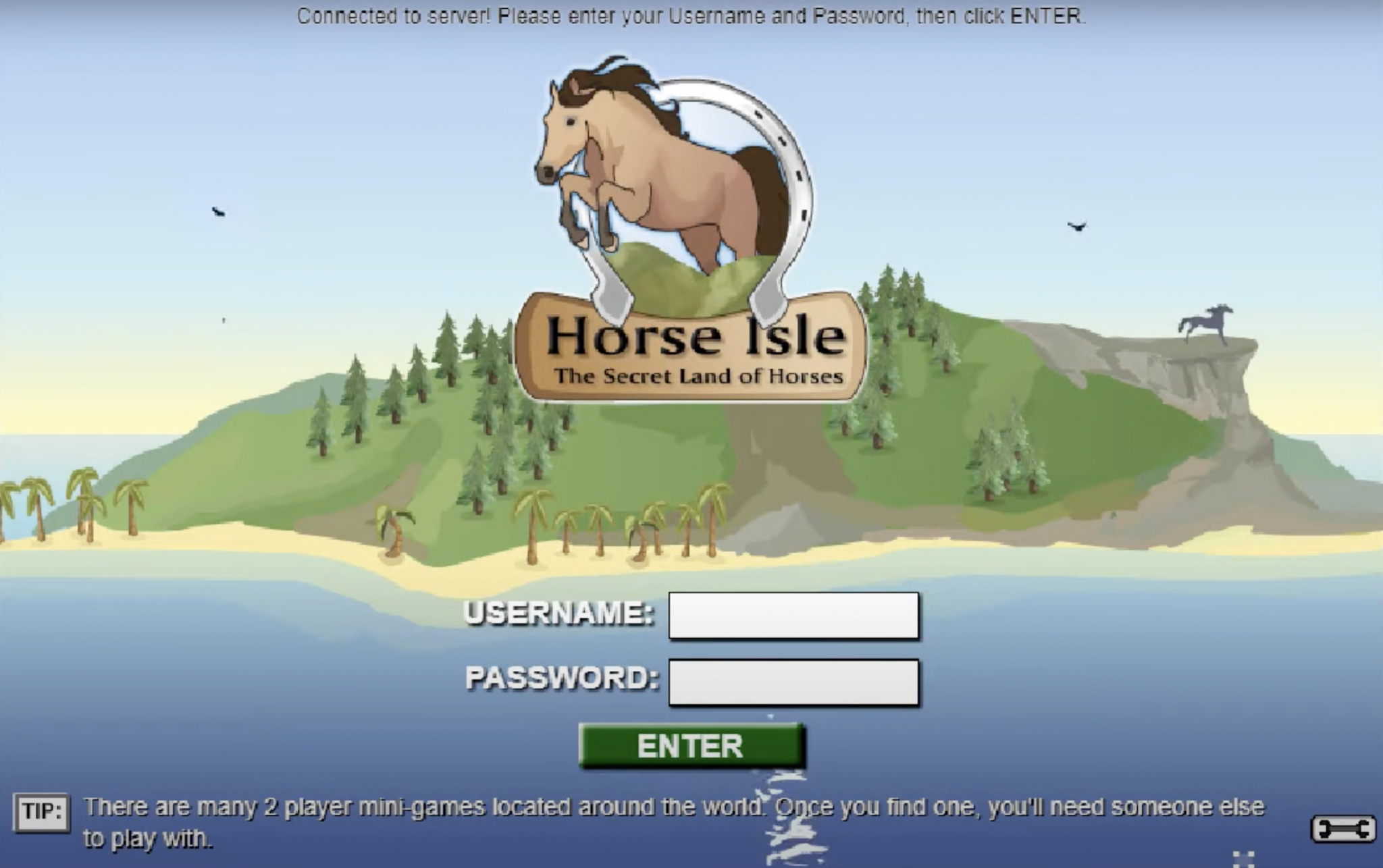
On May 3, 2007, Horse Isle 1: The Secret Land of Horses went live. Created by Joe and Miranda Durbin, the game is an MMORPG (massively-multiplayer online role-playing game) in a “vast multi-player horse based world” that allows users to chat, complete quests and own virtual horses that can be ridden, traded, cared for and enrolled in competitions. With 30 unique ‘isles’ that can be travelled to via ship for in-game currency, the quest list featured in the game is extensive and provides players with months of content. Entirely created in 2D, the game relied on Adobe Flash Player – an issue in today’s gaming landscape.
To gain a better understanding of the MMORPG genre and the long-lasting impact of flash games, I talked to Michael Hancock, instructor KS215: Game Cultures at Laurier.
Hancock details how games in the MMORPG genre include a “a level of community and individual quests”, elements Horse Isle has. However, Horse Isle does not feature the same level of violent combat that many MMORPG’s, such as World of Warcraft, have. This is due to Horse Isle’s label as a game for all ages – the website itself even having a section that states Horse Isle’s “educational benefits” alongside its rules that help to protect young players.
As explained by Hancock, “not enough MMORPGS like explore that space – what else can you do in a game besides the more combat based stuff.”
In addition, traditional MMORPGS often offer “a level of community and individual quests but also combat against each other that can create rivalry but also a high level of cooperation whereas a more kind of combat-focused thing like your match-based Call of Duty or something that tends to go a lot more towards more attacking” can lead to “aggressive behaviour”
Horse Isle, as a unique MMORPG, does not have any kind of aggression – unless, of course, activities like showjumping tend to raise your blood pressure.
Another unique element of Horse Isle is its overwhelmingly young audience. With this comes a multitude of issues – Hancock notes the difficulty in keeping young gamers safe online: “how do we take online connectivity in such a way that kids can be connected to each other, that they can develop their own social beings outside of adult influence but still be kept safe.”
Even with these worries, Horse Isle creates a unique space for young gamers: [There is] “a lot of possibility, a lot of chance for exploration and I think that’s important for a kid when it comes to long-term play. That there’s something here that I can share with my classmates – is there something here that I can – that I can use to pursue a fantasy of mine that I can’t pursue in the real world”, elaborates Hancock.
Further, as a game running on Adobe Flash in 2007, Horse Isle fit right in with other popular games of the time running on the same software.
Any child growing up in the 2000s with the internet knew of Adobe Flash Player – the system was responsible for running many aspects of different websites. The fallout due to the loss of Adobe Flash Player was great.
“These were the games that were in a lot of ways the most accessible on a computer – you didn’t need a very advanced graphics card, you just needed an internet connection and to know where it was”, elaborates Hancock.
In addition, the discovery of flash games such as Horse Isle allowed for the “joy of discovery” that came with finding a flash game.
It just gives you the sense of finding “something cool”, says Hancock.
Due to the influence of Adobe Flash on gaming, many studies have focused on the issue of games being lost to time due to the absence of preservation.
“It kind of brings attention to the fact that preservation is not something that is always on the mind of game companies”, says Hancock. Of course, this is for a variety of reasons – “sometimes there’s just not the money in it to make that kind of thing viable and it also points to the challenges in creating for a system that you don’t have full control over.”
For those interested in the study of flash games, Hancock recommends the paper “Flash – Building the Interactive Web” by Anastasia Salter and John Murray.
While flash may be dead, 2D animation certainly isn’t.
2D spaces have an “accessibility” that is attractive to gamers. 2D spaces give “us a way of exploration that isn’t impossible in a 3D space but can – adds more complications sometimes”, says Hancock.
With its 2D graphics, Horse Isle has this same charm. While 3D animation rules modern gaming, 2D animation is nostalgic to many and still sees success – especially with games like Stardew Valley. While Horse Isle isn’t as well known, its graphics are very comparable to games like Stardew Valley with its bright colours and block-y look.
“There’s obviously a nostalgia factor for people my age but I think there’s also a level of affordance that it all offers,” Hancock says, speaking about 2D games.
This nostalgia seeps into Horse Isle – with the death of flash, many creative and explorative virtual worlds such as this one have been lost to time. They remain in the memory of some – after all these years, I know that I certainly won’t ever forget my time spent playing the game.
Today, Horse Isle still has a vibrant community – with its third iteration, Horse Isle 3: Infinite Wilds. The game still pulls in horse lovers of all ages, with over 3,000 active players. It is still continuously updated (the latest update was released on April 1, 2022) and is downloadable for multiple computer systems.
While it is wonderful to see the Horse Isle community still thriving, fans of the earliest version of the game have filtered out in favour of other games or Horse Isle 3. With modern flash workarounds, the game only has 1,654 active members – a shell of its former self.
This dwindling number represents the importance of preserving flash games – either with more modern “refurbished” versions or wikis that highlight the game’s legacy. Otherwise, wonderful games such as Horse Isle will be forgotten – the work of so many writers, artists and developers will be lost to time.
If you can, take the time to write about, look up and reach out about flash games that you remember playing – you never know, you may be a part of the effort to preserve the game’s memory.







Leave a Reply
You must be logged in to post a comment.