
It’s almost exam season. Instead of reading your 260-page textbook that you haven’t even cracked open, you’re more worried about the resume you haven’t updated for the past six months.
Well, we’re here to provide some tips and tricks on how to make your resume stand out from the crowd. By no means is this list exhaustive and while these tips have helped myself and my friends, there are a million different ways to make yourself stand out.
There are also no general rules to resumes — Stacey Campbell, a career consultant at Wilfrid Laurier University’s Career Development Centre explained there is no “one cookie-cutter resume” template and that resumes will change based on field, practice and what you want to achieve from applying to a position.
“Resumes are not historical documents, they are marketing tools,” Campbell said, referring to a post she recently saw on LinkedIn.
Here’s my resume. I made this before a job interview in the fall and the hiring committee commended me on it, saying its look and content were some of the main reasons they pulled me for an interview.
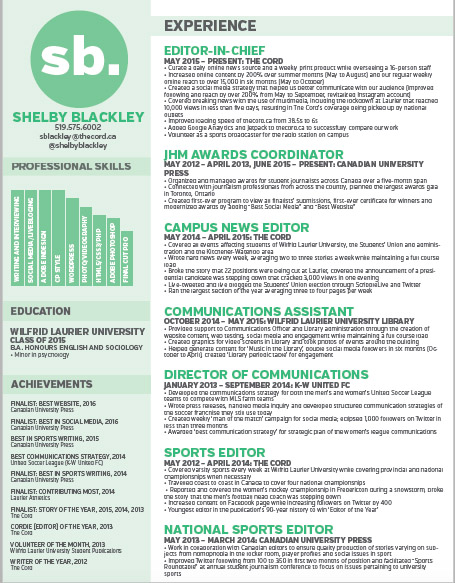
This isn’t the same for everyone. But these skills, combined with your own flare, will make you stand out the next time you apply for a job with 100 other applicants.
Content:
This is the most important section. It doesn’t matter if your resume has the best design or the worst — your content is what will determine if you get the interview.
According to Campbell, there are no cookie cutter resumes, so cater your experience to the job you are applying for. Know your audience and what key skills and experiences they are seeking.
Three words can sum up this entire portion: Keep it simple. Your resume in length should be no more than two pages — I don’t even like going more than one — and shouldn’t be some convoluted explanation of what you’ve done in a position.
This goes without saying, but work on a backwards chronological form. Put your most recent position first and work backward to your least recent. An employer wants to know what you’ve been spending your time doing, not what you did to first break into the job market.
Additionally, put your work experience first. Education and skills are awesome, but an employer wants to know what you’ve spent your time doing with your education and skills. Education often won’t tell the employer what your work experience can.
Get rid of the unnecessary content taking up space on your resume. There have been differing opinions on the objective, but unless you have a really good, direct and catered statement, get rid of it. It’s fluff, and an employer doesn’t care about your objective. They care about theirs and how you will fit into it. So show them with the content.
Customize your resume to fit the company you are applying to. If they are looking for a Digital Media Coordinator, your experience should advertise what the position wants and how you can provide it. If you have direct experience with the company, show that. I applied to a job that picked up my news story and wrote in the description “covered a national news story that got picked up by major news outlets like yours.”
Accomplishments over job description:
If your resume is just a reiteration of the job description you signed at the beginning of your position, a recruiter isn’t going to give a shit. A company isn’t looking for someone to say they successfully fulfilled what the position entailed — they’re looking for someone who can accomplish some great things.
“When you’re describing your experiences, you don’t just say the ‘what,’ you say the ‘what’ and the ‘how.’ You tell and you sell,” Campbell said. “We don’t just want to say we planned events for a campus club. We want to say we planned events for a campus club that optimized participation, it brought in 10 per cent more funds than previous sponsorship events.”
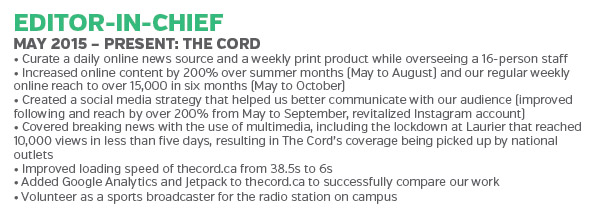
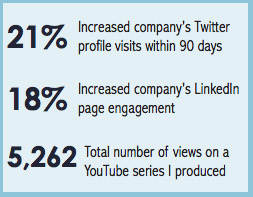
Stop being modest and say what you’ve done in a position. Did you completely redevelop their social media strategy which resulted in a 200 per cent increase in Facebook likes? Did you come under budget by 30 per cent but still meet your goals? Did you recreate their online digital presence to increase readership by 50 per cent in merely 30 days? Metrics and accomplishments stand out. Don’t be modest — be confident.
Design of the resume:
With the demand of visual creativity in a lot of fields, it’s important to make your resume stand out by how it looks. A typical word document is great if your field asks for it or you’re doing a quick summary of your experience, but you need to make yourself stand out when you get to applying for jobs that have 800 other people applying as well. A bold resume can make you stand out in a pile of plain-looking documents.
“Employers tell us within the first five seconds of looking at a resume, they already have a strong opinion about your candidacy,” said Campbell. “If you’re applying for the creative field and you apply with something as conservative as [a word document], you have to ask yourself, are you really making much of an impression there?”
So, how do you do this? Firstly, get rid of any rules and get creative. You can fit a lot of information on one page by playing with space and making it unorthodox. Create a sidebar with your education, skills and accomplishments so they don’t take away from your experience. Focus on simplicity when putting the title of the job, the length and location. Customize it to fit the brand you want to portray to a potential employer.
The best advice I was ever given when creating my resume was “play outside of the lines.” There’s an automatic one-inch margin on InDesign files or Word documents, but if you can make your resume outside of these constraints, you’re psychologically telling the hiring committee a bunch of things about yourself: you think outside of the box, you look for opportunities of creativity, you aren’t bound by rules, etc.
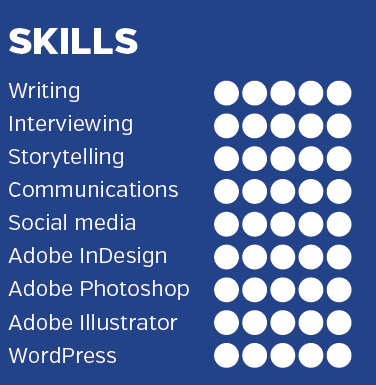
Even if the job calls for a “traditional” looking resume, playing outside of the margins can give you that psychological advantage. Campbell also recommended adding a simple graph or something unconventional to make it stand out.
“If seven people out of 10 like it, you’ve got a winner. But if it’s reverse, then maybe it’s time to start with a new appeal,” Campbell said.
Fonts:
I’ve always felt comfortable making a resume with sans serif fonts. These fonts are softer on peoples’ eyes, making it easier to read and more inviting. As students, we’re forced to use serif fonts like Times New Roman or Georgia, but I tend to lean toward fonts such as Calibri, Tahoma and Verdana.
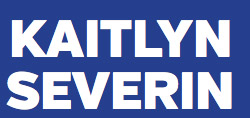
Never, ever use a cursive font — they are not accessible and incredibly hard for people to read, especially when only taking 30 seconds to glance.
Colour:
There are mixed opinions on this, but to me, colour is huge on a resume. It helps build your personal brand and can resonate with an employer. Colour also can be inviting for a hiring committee — they typically look at hundreds of black and white resumes. Colour gives them something different to look at.
If you don’t feel comfortable jumping head first into the world of colour on your resume, start by changing your name to a colour you feel embodies your personality and working skill.

Don’t know what that is? Here’s a brief summary:
Red: Expresses action, passion, power, control, confidence and courage.
Orange: Expresses determination, strength, encouragement and productivity.
Yellow: Expresses optimism, positivity, energy, vision.
Green: Expresses environment, youth, optimism, calmness, growth, idealism, rebirth.
Blue: Expresses trust, reliability, integrity, truth.
Purple: Expresses luxury, spirituality, inspiration or dignity.
When picking a colour, don’t pick your favourite colour — pick the one that best epitomizes your brand and communicates your attributes.
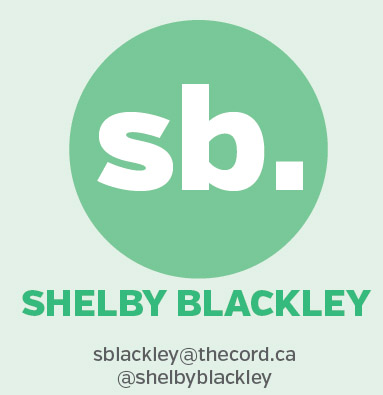
When using colour throughout your resume, don’t overuse it. It should stand out, but the entire resume shouldn’t look like it was dropped in a bucket of that colour. Pick a total of three colours — a main “branding” colour and then two accents, like grey, black, brown or white — to make your resume look professional.
Don’t stress too much:
We obsess and obsess over our resumes because we can control what happens with the piece of paper in front of us. But it’s also important to remember that a resume will only get you an interview — what you show the hiring committee will need to be more than what you’ve designed and is where your real skills are on display.
“Your resume is 85 per cent more likely to be read if you have had previous interaction with the hiring authority,” Campbell explained. “You can obsess over your t’s and dotting your I’s all you want, but you’re still a piece of paper. Paper is easy to throw in the garbage, but a person, a face to the name, is a lot harder to throw in the garbage.”
While a resume should be the best and clearest representation of your skills and experience, it’s only the beginning to a long and challenging endeavour.
Once you’ve landed the interview, well, that’s a whole other article.
Have more tips to add to this? Are we missing something? Let us know. editor@thecord.ca




Leave a Reply
You must be logged in to post a comment.