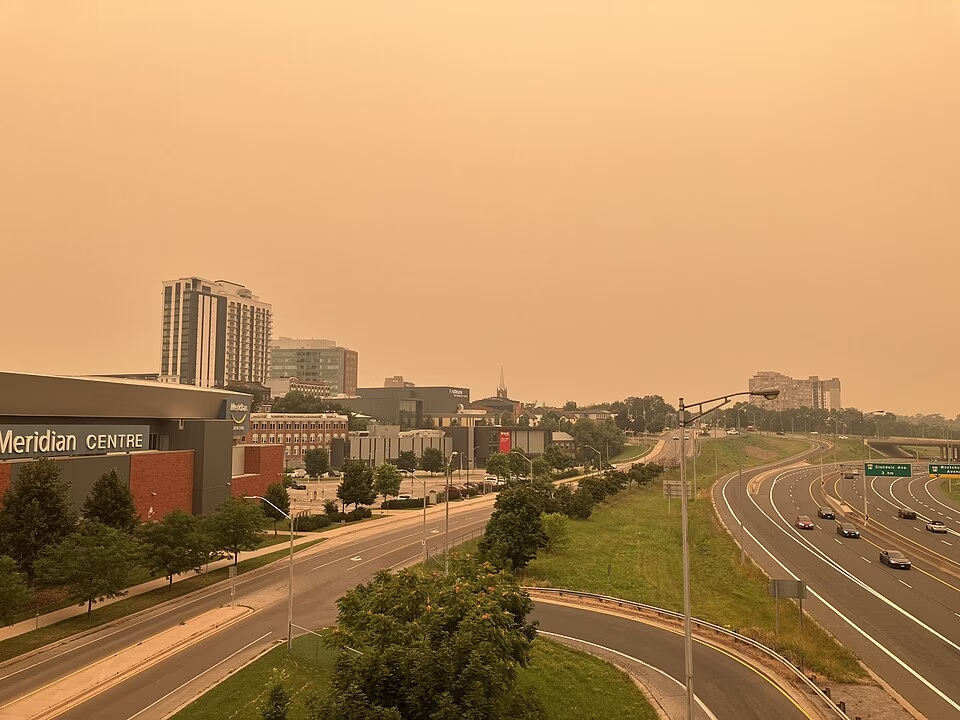
Kitchener-Waterloo is choking on an Air Quality Health Index (AQHI) reading of 10+ due to smoke from forest fires.
There are nearly 200 wildfires burning in northern Ontario. As of Tuesday evening, a reported 180 active wildland fires were located across the northeast and northwest regions of Ontario.
Ontario forest fire officials said there were 148 active wildland fires in the northwest region as of Tuesday, including 69 fires that remain out of control.
The fires have caused evacuation orders in several communities, including Armstrong, Lac La Croix First Nation, Collins First Nation, Whitesand First Nation, Gull Bay First Nation and Lac des Mille Lacs First Nation.
Namaygoosisagagun First Nation, also known as Collins First Nation, was approached by a fast-moving fire. The community is located about 210 kilometres north of Thunder Bay, and it’s not accessible by road. Because of this, people were evacuated on boats.
Siddharth Kishore, PHD student at Lakehead University and resident of Thunder Bay recounted his experience during the crisis.
“The fires were decently far from me, but the entire sky was brown and red for three days straight. There was ash everywhere and if you stay out long enough, you start coughing.” Said Kishore.
Here in Kitchener-Waterloo, the current AQHI, calculated at 6:00 p.m. EDT on July 15, was 10+. With a normal range being 1-3, this is considered a high-risk zone, and air quality is significantly impacted.
Wildfire smoke can be carried thousands of kilometers away from the fire zone. Meaning that smoke can impact air quality in areas both near and far from the wildfire.
Exposure to smoke can negatively impact your health. Many of the pollutants in smoke, such as fine particle matter, have no known safe level of exposure to humans. This means that smoke can affect you even at very low levels.
As smoke levels increase, your health risk increases. During heavy smoke conditions, every person is at risk no matter their age or health.
In the summer of 2025, wildfires burned nearly 600,000 hectares across Ontario, more than the entire size of Prince Edward Island. Wildfire season, amplified by climate change, is getting hotter, drier and more frequent.
Ontario premier Doug Ford said in a statement that the government will not spare a penny to keep people safe.
“Right now, the Provincial Government has 156 fire crews, and nearly 50 waterbombers and helicopters hard at work across the impacted areas with more resources being deployed where needed.” Ford said.
In 2025, Ford cut the province’s budget for emergency forest firefighting from $177 million to $135 million, with $4 million cut from emergency preparedness funding.
Due to the high to extreme fire hazard, and to reduce the number of human-caused wildland fires, the Ministry of Natural Resources will be implementing a Restricted Fire Zone (RFZ) effective July 15 in northwest Ontario.
Fire season in Ontario runs from April 1 to Oct. 31.
Contributed Photo/Wikipedia Commons