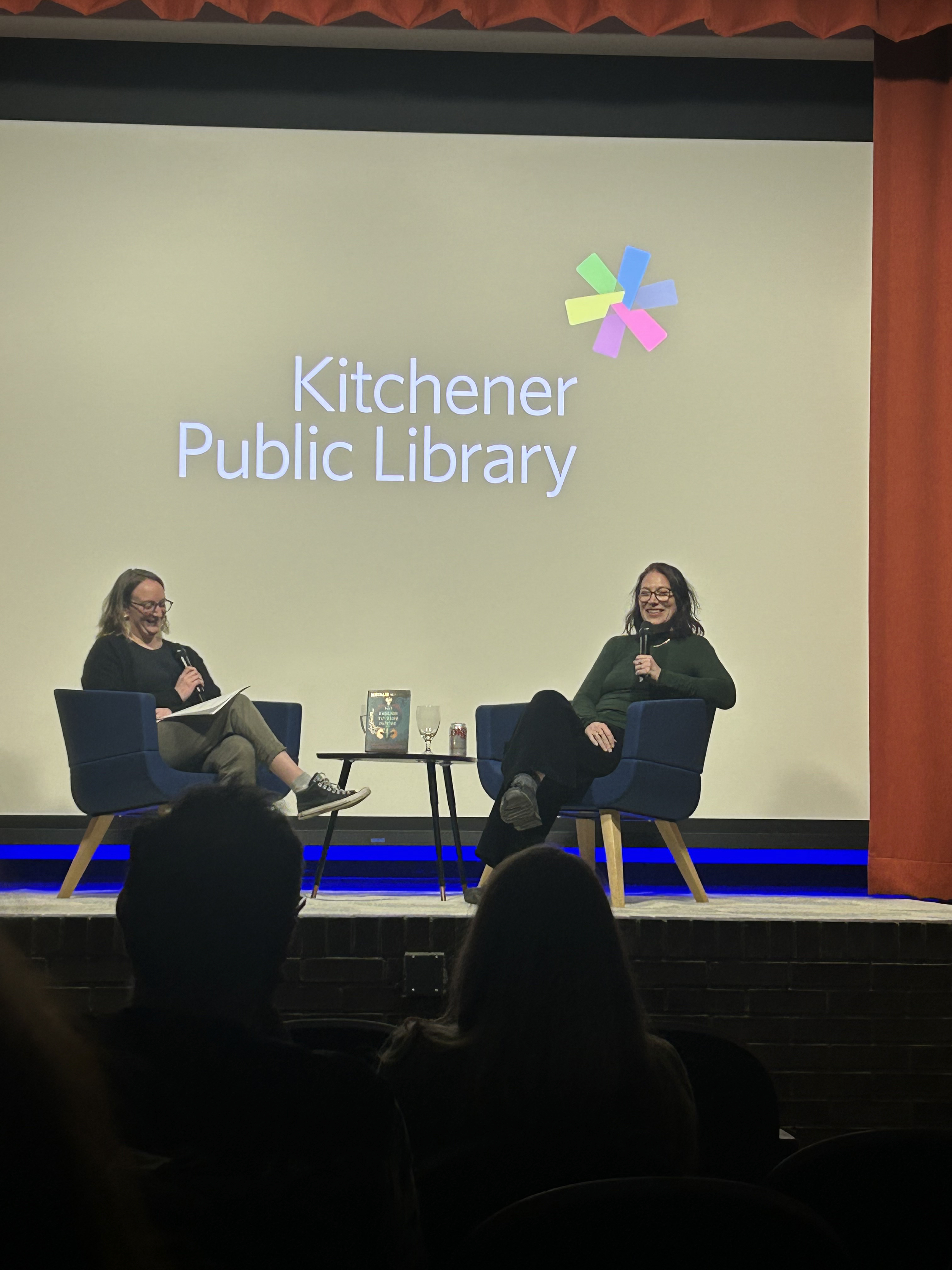
There is something slightly disorienting about someone laughing during a discussion of a mother killing her children. But that is exactly what happens when British Author Natalie Haynes speaks on Medea, the mythological figure who commits infanticide to exact revenge on her husband. On March 16, the Kitchener Public Library hosted Haynes in conversation about her latest novel, No Friend to This House (NFTTH). Revisiting one of the most infamous figures in Greek myth, the novel offers not a retelling of Medea’s story, but a reframing that asks what it means to see her not as a mad woman, but as a person.
Blending dry humour with deep knowledge of the classics, Haynes approaches Greek myth in a way that feels less like a lecture and more like a conversation. The classics, as she presents them, are not fixed texts to be preserved and held at a distance, but stories that shift depending on who is telling them and who is listening. “Every time you return to a text, it changes, because you have changed,” Haynes said. The author has spent years with Medea – in fact, her undergraduate dissertation was titled “The Heroics of Infanticide: a comparative study of Euripides’ Medea and Hecabe.”
The long standing relationship is evident in the way she writes Medea. When asked in an interview what drew her back to Medea for this novel, Haynes answered, “I never left her.” During the talk, Haynes described Medea as performative and ever-changing, someone who cannot be reduced to a single version of herself, not a fixed symbol of violence, but a life in motion. This complexity is what makes her so unsettling. She is, as Haynes writes in Pandora’s Jar, “a complex female character with multiple internal forces pulling her in different directions.”
One thing that was evident in the event which reflavours the serious tone of the novel was its creator’s dry, British humour. At one point, Haynes compared Medea’s delayed entrance in the novel to “waiting for the shark in Jaws.” Elsewhere, she spoke about writing the novel during lockdown, describing how the characters became a kind of surrogate family. “I handed it in like homework,” she said. “And then… I cried for two days because I missed them so badly. I miss my made up family. You know, like a sane person would.” This humour, often arriving at unexpected moments, reinforces the author’s intensely familiar relationship with the figure, with whom she has lived for years. These moments of levity do not soften her approach to Medea’s story. By grounding the myth in emotions like grief, isolation and anger, Haynes refuses to let Medea remain distant or symbolic. She becomes recognizably human, and therefore far more difficult to dismiss as just another mad woman in Greek myth.
This is ultimately what makes Haynes’s work so compelling, her Medea’s crime is presented as the only kind course of action. She does not just humanize Medea, but forces us to sit with a version of the story in which Medea’s infamous act becomes horrifyingly understandable. In No Friend to this House, the killing is reframed as an act of mercy, a choice made in the face of inevitable violence – not as an act of revenge.
Contributed Photo/Sneh Leighl