Before life began on this planet nearly four billion years ago, the closest thing to any form of life we would recognize was a variety of molecules bouncing around, occasionally interacting with each other, but never forming anything substantial or lasting.
Carbon changed this: with its stability, flexibility, and ability to bond with up to four other atoms at once, more complex structures began to form. But of all of carbon’s traits, the rate of self-replication would be vital in determining the manner of life on Earth. All of Earth’s organisms, from microbes to whales, possess the same innate, yet subconscious, goal to replicate, originating from the original chemical process of a carbon atom’s self-replication.
If life creates more life because that is the only way to continue carbon’s process of multiplication, then it could be inferred that all life likely originates from the sole replication of a single carbon atom. This original atom has copied itself ad infinitum, eventually resulting in the world we know today, with the time between these two points being filled with all the species that have ever existed competing over the same finite resources necessary to replicate more carbon atoms. Humans are the first species to understand this process, and while we ascribe ‘meanings’ to our lives, our objective in life will always be to multiply, a truth we can never escape.
On October 27, 1962, during the height of the Cuban missile crisis, in the Southern Sargasso Sea, just north of the Bahamas, a submerged Soviet submarine, cut off from radio contact and under pressure from American ships and search planes circling above, was weighing its options. For a nuclear warhead to be launched, the three most senior staff in the submarine must agree to launch it, with two of the three in this instance giving the go-ahead to launch, but the second-in-command, Vasily Arkhipov, sided against the other two, single-handedly saving the planet from a thermonuclear war.
That is the closest we have ever come as a species to annihilation, and while the Cuban Missile Crisis taught the world that nuclear weapons must be regulated, the broader lesson of self-destruction seems not to have been learned.
At the time of this publication, AI has seemingly replaced both nuclear war and climate catastrophe as the new manmade manner in which we may annihilate ourselves. Since only humans are capable of creating these extinction-level situations, it may benefit us to consider that while we view the other inhabitants of this planet as beneath us, no worm has ever run the risk of obliterating its own species.
With this in mind, if evolution is simply the natural process by which the most efficient forms of self-replication kill off the weakest forms, then is the high intelligence only humans possess a positive or negative evolutionary trait? On one hand, humans have made it this far because of our high intelligence, and while opposable thumbs and endurance hunting were vital for success in everyday Neolithic life, our intelligence allowed us to outcompete other hominids. On the other hand, humans are uniquely skilled in inventing ingenious ways to bring death and agony to one another, a trait not usually associated with a productive form of life. When in competition with other species, our high intelligence and ability to shackle nature to our will are undeniably beneficial, but that very same intelligence could be detrimental, or possibly world-ending, when the only competition is ourselves.
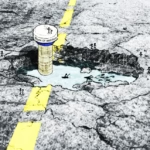
Graphic by Kenzie Miller