

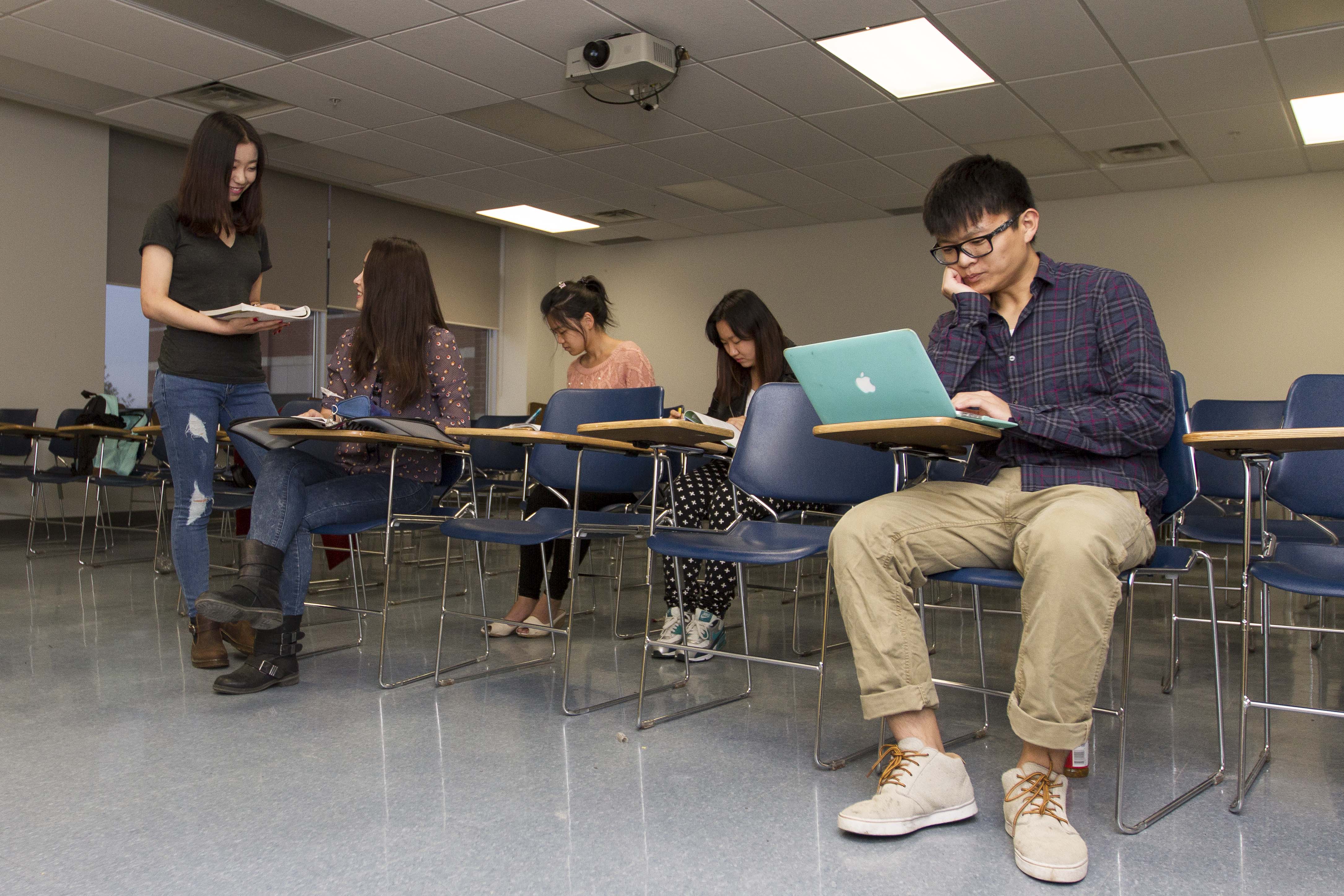
Wilfrid Laurier University’s enrolment on the Waterloo campus for 2014-15 is expected to be down an estimate of 250 students, with the official enrolment numbers to be released on Nov. 1. As school is now a few weeks into the term, students will have noticed if this has had an impact on their experience at Laurier.
Ruth MacNeil, acting university registrar, said the decrease in enrolment is not a large enough number to come into play for classroom sizes, continuing that most of the impact is at the first-year level.
“There’s always going to be some attrition — students decide they’re not going to come back after first-year or decide to graduate early and don’t go into fourth-year.”
Accordingly, if students going from first-year into second-year notice a difference in their class sizes this might not necessarily be due to the enrolment gap, but rather is a regular occurrence.
MacNeil explained that most of Laurier’s upper-year courses are between 30–60 students, which is normal for university.
According to a 2012-13 table from the Ontario Universities’ Application Centre that outlines the class sizes by year level, the majority of second and third-year classes at Laurier were between 30–60 students and 61–100 students. In second-year, 38 per cent of classes were between 30–60 students, and only .9 per cent of classes were over 251 students.
In third-year, 56.5 per cent of classes were between 30–60 students, and there were no classes with over 251 students.
MacNeil said the 2012 numbers and the current numbers haven’t seen much variance.
A decrease in the amount of bodies in classes, MacNeil said, could be attributed to students’ decisions when it comes to course selection. Programs such as English have a diverse range of courses students can take to fulfill their requirements.
“It’s up to the student to register for the course. So if you [like a certain course] but it doesn’t fit in your schedule … then that comes into play as well. It’s all about freedom of choice,” MacNeil said.
Madelaine Hron, an associate professor of English, teaches two second-year classes this semester. According to LORIS, although both courses have a 60-student capacity, only 24 and 13 students are in her classes.
However, Hron finds having fewer students in her classes to be a positive thing for her teaching.
“For me, it’s an opportunity to get to know the students better and we’ve had really good discussions,” she explained. “It’s a different way of teaching … but I’m getting some good discussions and students can really learn how to think critically as opposed to the huge classrooms.”
Hron said the smaller classrooms are a lot more personable and that she is able to bring in more engaging discussions.
Holly Baines, a contract academic staff in the departments of sociology and women and gender studies, said that while her class sizes have remained near the sociology enrolment cap, they are fairly small classes. The sociology cap for fourth-year courses – which Baines teaches two of – is 25 students.
“I think a smaller class is far more valuable when you’re talking to upper-year students,” she explained. “The expectation for upper-year students is that they dig into the material … and have an engaging conversation about that.”
Baines expressed concern that even 25 people in a fourth-year seminar can sometimes feel too big.
While MacNeil said the anticipated drop in enrolment this year is a “one-off” experience and that the population will continue to expand.
“If you look at the size and population of Laurier, and we are getting bigger, it’s not enough of a number to make a significant difference in terms of class sizes. Even if it’s one person per class, it’s not that much of a difference,” she said.
The university could experience a minor issue with classroom availability when the Global Innovation Exchange building is ready for use, as class sources and materials will have to be moved from the current Schlegel and Peters buildings. The university experienced this when the St. Michael’s campus went offline and they lost a number of available classes for the courses available.
However, while the university looks forward to the growth in the population, not everyone feel the same sentiment. Both Hron and Baines expressed concern over the growing desire for Laurier’s larger class sizes and larger overall population.
“I’m just worried that the constant push for growth is not helpful for Laurier’s identity and Laurier’s students,” Hron explained.
Baines stressed that Laurier’s reputation as a “small school” could be ruined by the consistent expansion.
“I feel like there was a moment in time when Laurier was the small, intimate university that could pride itself on being the small, intimate university,” Baines said.
“I think in some ways, we’re still a small university trying to be a mid-sized university and don’t quite know how to do that yet.”





Leave a Reply
You must be logged in to post a comment.