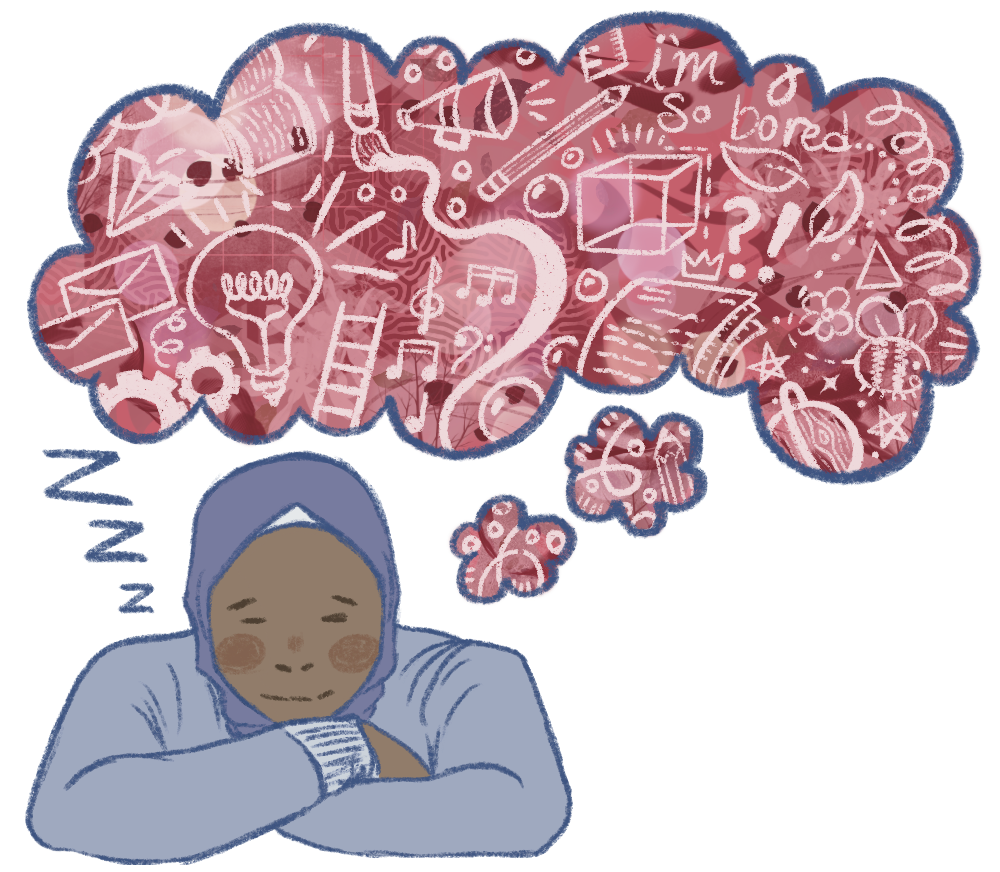
Boredom is something that everyone has experienced, yet despite being a worldwide occurrence, nobody talks about it seriously. Most people brand boredom as unpleasant, useless or something to be avoided at all costs. But in my opinion, that could not be further from the truth. We need boredom, and it is incredibly useful; but right now, as a society, we are bad at it.
Boredom occurs when an individual is unable to engage in satisfying, or meaningful activity. It is a state of desire for purpose and is only satisfied with an objective. In the past, boredom would force people to think harder, try new things and create. Bored people found hobbies to fill their time like reading, drawing, writing, cooking; anything that could capture their attention.
This pressured them not only to explore what the world has to offer us, but to actively use their minds and think critically and creatively. It helped develop useful skills in everyday life and boosted the happiness of individuals as boredom gave them the time and drive to enjoy and explore their hobbies.
Today, however, we have immediate dopamine hits right at our fingertips, just a swipe away on our phones. Before we even have the chance to be bored, some devices are in our hands, and we are doomscrolling once again. We do not do the things we used to when bored and this is what will be our downfall.
Boredom has been a major component of our lives that has guided us to explore the arts, and now with screens replacing that urge to make and perform art, our creativity is being diminished. This not only affects us as individuals, but also as a society. This lack of creativity is pushing uniformity in communities, reducing our ability to adapt to complex situations and causing us to lose what makes us individually unique.
As creativity fades, we resort to screens to create for us: we use AI to make our art, use ChatGPT to write our stories, use social media to develop opinions for ourselves. Original ideas are becoming increasingly rare, and the arts are becoming less common than pastimes. People read less, draw less, write less; we are losing our expressiveness and our innovation, and it will be harmful to our society when we can no longer think for ourselves.
Proper boredom could solve this issue by reigniting our desire to create.
Boredom is not just good for us in the creative sense, though, but in the analytical sense as well. When one spends every day with an active mind—working, studying, going to classes, and scrolling through their dopamine hits—they do not end up with much time to just think. To sit down with only their mind, reflect seriously on life, and draw conclusions.
Without this time to ponder, there is not as much opportunity to form one’s own opinions, to explore one’s potential passions, and to achieve well thought through decisions. Instead, opinions are formed for you, passions are chosen by convenience rather than exploration, and decisions are made more hastily, which may lead to future regret. Real boredom grants us the time to think through what has happened, all the possibilities that come with it, and it allows the time to come to one’s own conclusions about it. It is much harder to do this when scrolling on a phone is the default solution to boredom.
With all of this being said, I urge you to take action.
Instead of reaching your phone at the first sign of boredom, embrace it. Take in the quiet, the lack of a job to do and use this boredom to explore the world and your own mind, to find passions, and to come up with your own original ideas. Being bad at boredom is not a small thing to laugh about and it can be detrimental to us as people, so let’s fix it.
Boredom is the key, in my opinion, to a more unique and interesting future, and changing the way you do boredom could be the first step to saving your originality and finding things that make you, YOU.
Contributed Graphic/ Anna Koehler