
News Director Madalyn Mostacci explores a study detailing the role rodents can play when considering studies for metabolism.
The Mozart Effect claims that listening to Mozart or classical music more generally can make someone more intelligent, but researchers and student composers at Laurier and the University of Alberta have asked the questions: “What if it’s not just classical music?” and “What if it doesn’t just impact intelligence?”

Tony Kiang and Ayman El-Kadi from the University of Alberta’s Faculty of Pharmacy and Heidi Ahonen from Wilfrid Laurier University’s Faculty of Music push conventional boundaries.
Together, they mix two contrasting disciplines – science and music – in a study titled “Effects of Music on Drug Metabolism and Pharmacokinetics.”
The current study aims to prove that music, while not likely the only variable, is an important factor that must be considered in drug therapy to further improve precision dosing.
“It’s always music that we are familiar with that has lots of therapeutic benefits,” said Ahonen, one of the study’s researchers and a music therapy professor at Laurier. “It has different hormonal benefits, so it would make sense to see if it also has benefits around metabolism.”
The team of researchers hypothesize that the “modalities of music can affect how the body clears or metabolizes the drug differently,” explained Kiang, the principal investigator of the study.
“Some elements of music may enhance the metabolism; some may reduce the metabolism,” she finished.
The ultimate goal is to improve the care of patients, said Kiang.
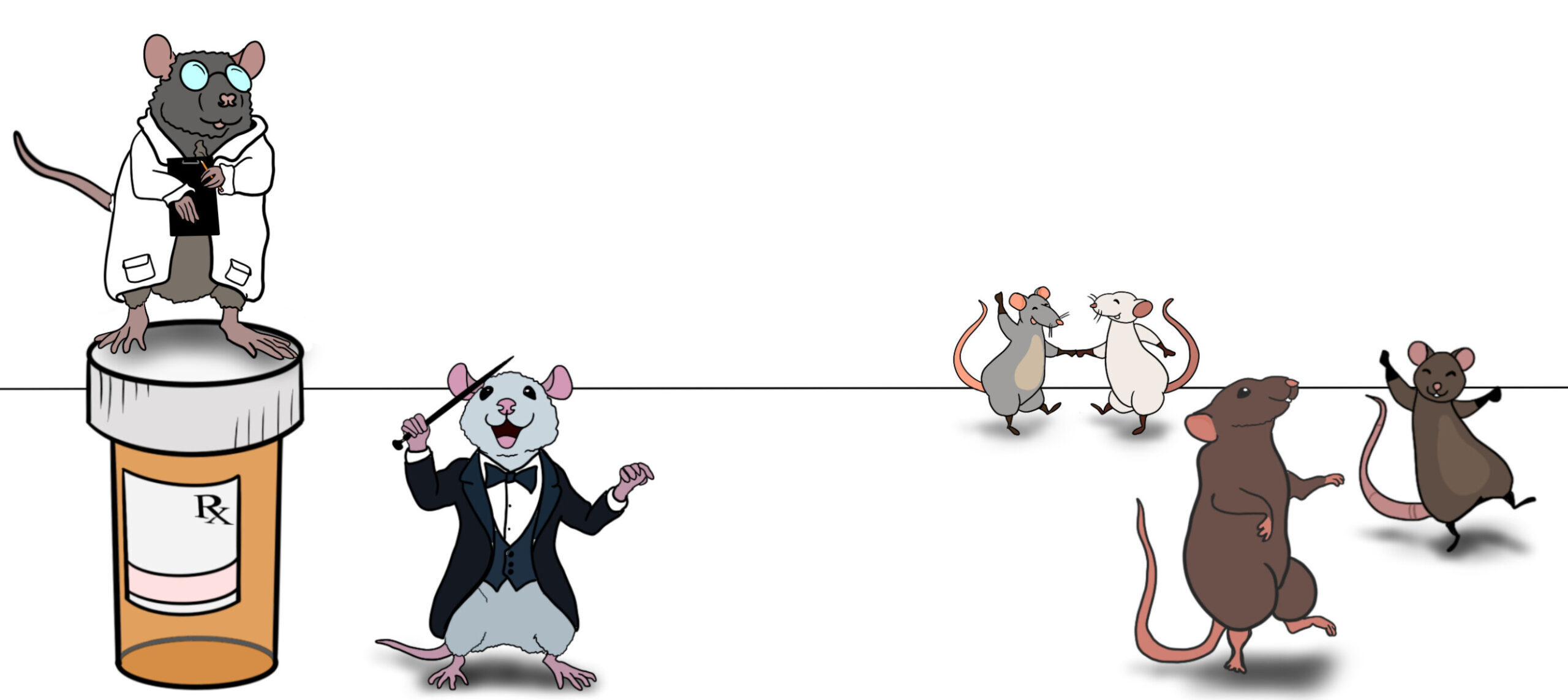
Before the effects of music and drug clearance are studied in humans, Kiang, El-Kadi, and Ahonen will observe results on Sprague-Dawley rats.
“[Other studies] have made rodents listen to Mozart, rock and roll, and Schubert,” Ahonen said.
The effects of seven variables — or modalities, as Ahonen refers to them — of music will be examined first in rodents and later in humans.
These variables include tempo, rhythm, genre, harmony, dynamics, auditive frequency, and vibrational kinesthetic, which refers to vibrational sensations throughout the body.
To decide what variables to use in the study, “I first had to think, ‘what is music?’” said Ahonen.
“As a music therapist, I find that sentence very irritating. People say that music is powerful and therapeutic, but don’t define what parts of music because music can be anything. Music is really a combination of different elements,” she said.
Four Laurier students: Drew Aarssen, Callum Drysdale, Jasmine Hourahine, and Dylan McIsaac, were hired to compose music that will be played for the rats.
Barbara Assiginaak, a composing professor at Laurier, assisted them as they composed their pieces.
After completion, their compositions were sorted into three categorical groups.
“There was group one that was the rhythmic, tempo, and percussion only, and then group two that included instruments, and then group three that included the low frequency,” said Ahonen.
When they go for testing in Alberta, recordings of the music will be played to the rats in a comfortable environment, explained Kiang. Each element of music will be tested on the rats one at a time.
“We’re very careful in making sure that the music is not too loud. We’re going to control everything by decimeters,” he said
“Essentially, they’ll just listen to music and be able to roam around and eat.”
At this point, the researchers don’t know how long the rats will need to be exposed to the music.
More testing is required to determine how much time is enough to get reliable results, Kiang added.
“We’re looking at potential changes to how [the rats] metabolize drugs,” Kiang said. “In essence, we can measure specific metabolism pathways and we’re able to see whether music can upregulate or downregulate those specific pathways.”
“Potentially, you could see an increase in metabolism, but you could also see a decrease in metabolism,” he explained.
Kiang outlines that a successful experiment is one where they can prove their hypothesis — that certain elements of music have specific responses in metabolism.
“For example, when you listen to fast tempo music versus slow tempo music, we anticipate that will have different effects on the same metabolism enzyme,” he said.
The researchers are still in the early stages of their experiments. “Over the next half a year, we’ll be testing our hypothesis systematically,” said Kiang. “I would imagine in the next year or so, maybe we’ll see some results.”
In later stages of the study, they plan to test their hypothesis on humans in a non-invasive manner.
“The human subjects will also listen to the music in a very comfortable environment,” explained Kiang, and they won’t need to take any additional medications or drugs either.
“We’re simply taking a blood sample from them, and from that sample, we can measure if those endogenous, or natural compounds, which represent metabolism pathways, have changed in response to music.”
Interdisciplinary collaboration allows for new possibilities of research and learning that otherwise would not have been explored. It’s through this collaboration that seemingly random topics like music composition, Sprague-Dawley rats, and pharmaceutical science can unite.
If the study finds that music can improve the intake of drugs used for treatment, music wouldn’t replace traditional drug therapy altogether but could be used in addition to it.
“The only way to establish that would be to combine two very different disciplines together, which is what we have in this case,” said Kiang.
“I’m quite excited about this research,” he concluded.







Leave a Reply
You must be logged in to post a comment.