

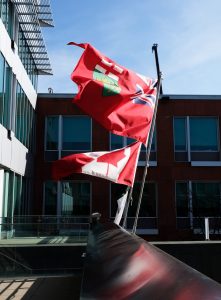
This past Friday, Feb. 28 at 11 am, students and faculty at the Wilfrid Laurier University faculty of social work in Kitchener gathered to prepare for a walkout in solidarity with Indigenous communities across Canada who are currently protesting.
A Facebook page for the “Student Led Wet’suwet’en and Tyendinaga Solidarity Gathering” wrote that the walkout was “to show support for Indigenous sovereignty, and demand the RCMP and other police get off Indigenous land.”
The walkout was planned by Indigenous and non-Indigenous students at WLU. Students, staff, and community members travelled from the Faculty of Social Work to King Street, in front of City Hall. The group blocked traffic in front of City Hall, as they spent the lunch hour listening to and participating in drumming, speeches, and a round dance led by Indigenous students and community members.
Despite the cold, many students turned out to show their support and listen to the speakers touch on issues such as Indigenous-settler relations, the environment, and holding the government accountable.
This protest occurred in the wake of demonstrations and blockades across Ontario and Canada supporting Wet’suwet’en hereditary chiefs, including recent arrests that occurred at a blockage in Tyendinaga, near Belleville, Ontario.
Monica Van Schaik is a current Masters of Social Work student at WLU and identifies as a Dutch-Belgian-Canadian settler. “I’m here in solidarity with the Wet’suwet’en people and other indigenous communities who are standing up to defend the land right now,” Van Schaik said.
Students were encouraged to join the walkout “in order to stand in solidarity for Wet’suwet’en and defenders, to stand up for the land, and the waters, to protect the earth.”
“I feel really called to stand in solidarity with Indigenous communities. I feel greatly worried about our land and our earth, but I also feel a lot of accountability and responsibility to uphold the treaties that we agreed to,” Van Schaik said.
Van Shaik emphasized the Two Row Wampum treaty that her ancestors agreed to.
“That treaty talks about how we’ll travel down the same river together, without interfering with each other. And the Canadian government has interfered with Indigenous peoples and has continued to perpetuate state violence and land violence and all kinds of violence and discrimination of indigenous peoples,” Van Schaik said.
“So I think that what’s happening in Wet’suwet’en territory right now is a continuation of that. So I feel a great deal of responsibility to stand up in solidarity and to try to hold the government that represents Canada, which is the country I’m apart of, to account to allow Indigenous sovereignty to happen, to respect Indigenous governance systems, and also to take the time to understand those and to respect them and to follow what the Wet’suwet’en hereditary chiefs and peoples are asking for.”




Leave a Reply
You must be logged in to post a comment.