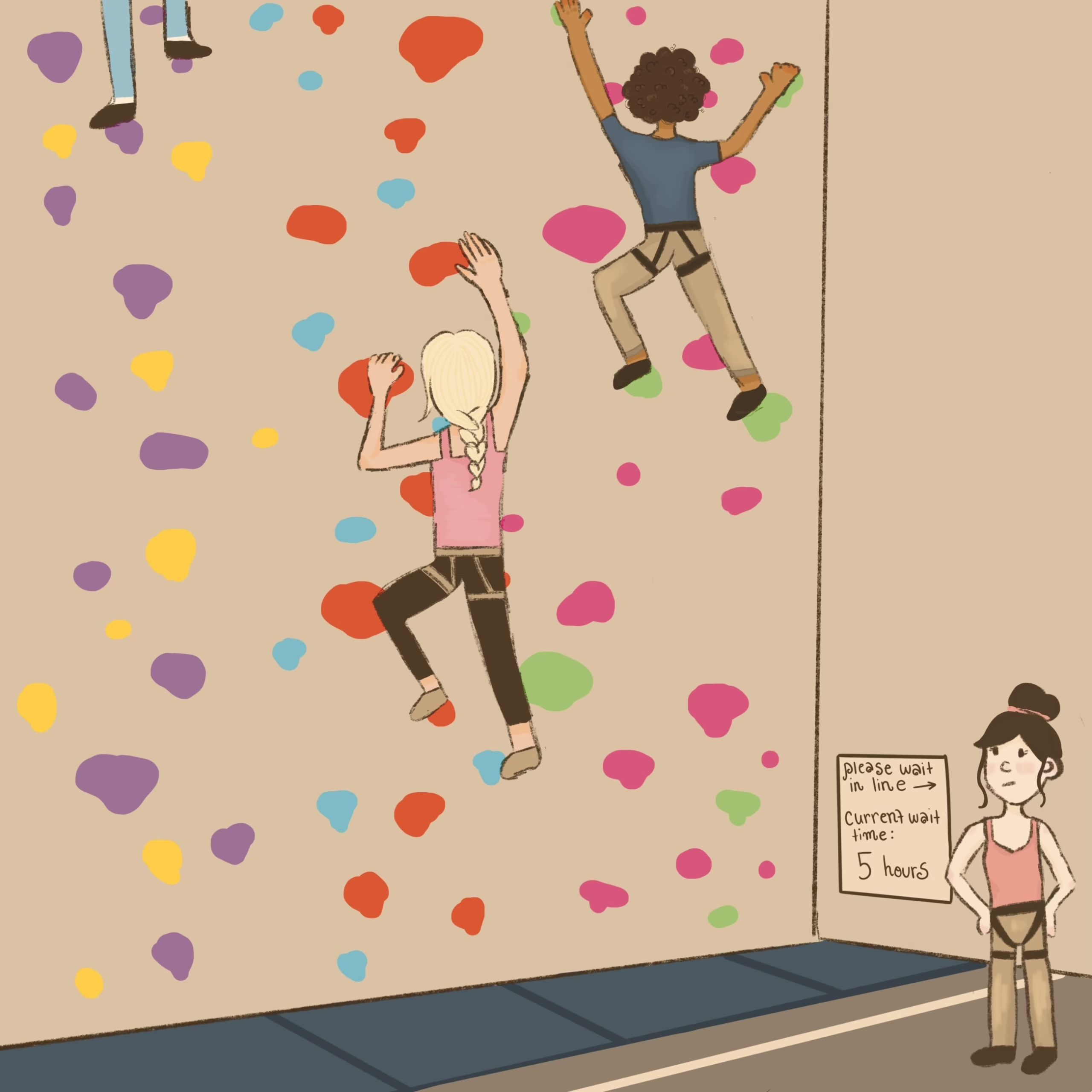
Is climbing losing its soul? Is social media changing rock climbing forever? Why has everyone suddenly started climbing indoors? Is this the future of climbing or just high-altitude cheating? All these titles are what popped up from one quick Google search of the question, “Is rock climbing too mainstream?” An ongoing debate within the climbing community, and if its booming popularity is affecting climbing’s vibrant culture for the worse.
The source of this question came from an experience I had with a long-time climbing partner. Two men came up to us and, without prompting, they began explaining the route and its complex attributes, and described plenty of climbing terms incorrectly. Though annoyed, as we were very familiar with these descriptions, It inspired us to discuss whether rock climbing was a little bit too popular now, and if it was for the better or the worse.
For some background, climbing’s evolution throughout all its disciplines is intricate. The sport itself began as a method for exploration, hunting and military efforts, but became more recreational through European mountaineering. It later became relevant enough to build indoor climbing gyms, which supported year-round training and eventually led to competition climbing. Today, popularity is at an all-time high with the release of documentaries like Free Solo and The Dawn Wall, as well as bouldering, sport, and speed climbing making their first appearance in the Tokyo 2020 Olympics.
Our conversation on the topic of its popularity ended with the consensus that it was not too mainstream, though we were somewhat annoyed by this interaction. We determined that climbing has many more levels to it now — levels that refer to more than just climbing difficulty.
The media’s promotion of climbing through film and social media has allowed people to see the approachability of the sport. Since climbing can be an intense sport, it can seem intimidating to start. Therefore, the public getting to see familiar faces, such as influencers they idolize, opens doors for public participation. However, due to limited information, it is sometimes labelled as a niche hobby. This portrayal may be disagreeable to the climbing community, as climbing is very much a lifestyle. Regardless, sharing new personal experiences is admirable and necessary.
From my experience as a climbing coach, I found it incredibly fulfilling to teach and coach the sport to beginners, as well as advanced climbers. Sometimes people say they wish they could watch their favorite show again for the first time, and I feel the same way about climbing. How could I ever want to be a gatekeeper for that passion?
Climbing culture is incredibly deep, encouraging and embracive. I truly think it is a injustice to exclude others from such an opportunity. If you’re a climber and do think climbing is mainstream and that we must protect it from all this attention, I can agree with you in some senses. It’s hard to believe some people see it only as entertainment or an occasional hobby and are not diligently training for competition or preparing for the dirtbag life. But, also, everyone has to start somewhere.
To reframe the question, for some perspective: is hockey too mainstream? Seems a ridiculous ask, right? But we know it wasn’t always so popular and its growth allowed for near worldwide recognition. Do climbers want the same?
Contributed graphics by Kenzie Millar