

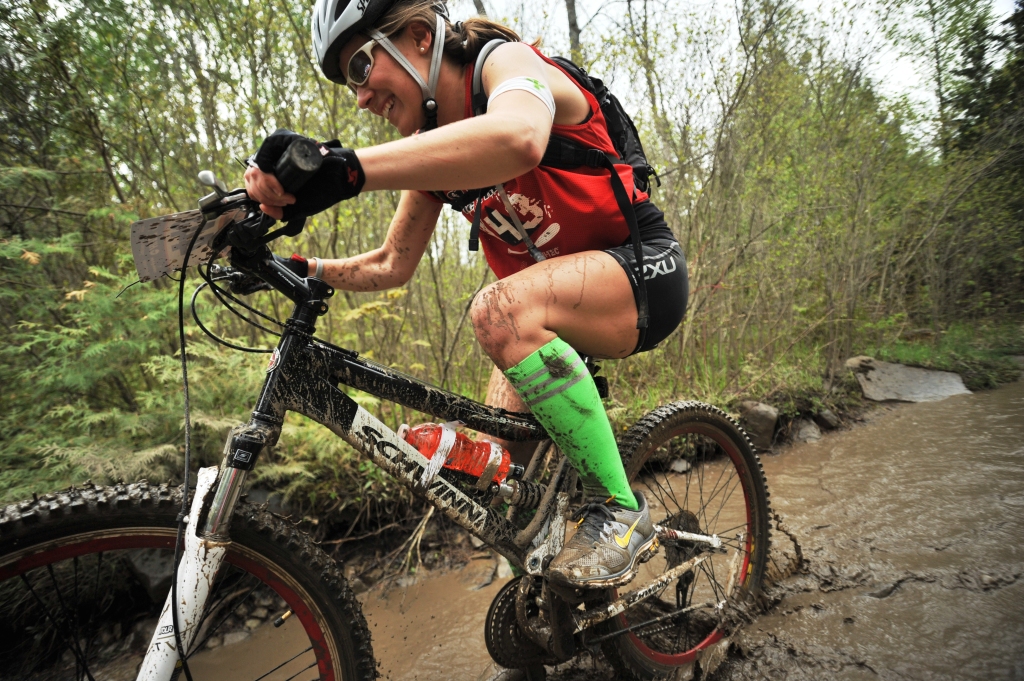
Endurance sports and road races have taken Sally Heath to Virginia, Sean Roper to Tasmania, and Bob Miller to Abu Dhabi. They’ve spent nights mountain biking, days trekking, hour upon hour canoeing and have done their fair share of horseback riding, ropes courses, rock climbing and every discipline in between. Maybe this summer you’re looking forward to four months of pounding kilometers out on the pavement on your daily road run. Or maybe it’s another summer of work, or just you and the couch. That’s no different for Heath Roper, and Miller, but when it’s time for a change of pace they are nowhere near the road, or a couch, or civilization for that matter. They’re adventure racing.
“It’s kind of like a camping trip on steroids,” explained Miller, who is the president of the Canadian Adventure Racing Association (CARA) and an international adventure racer. Unlike marathons and triathlons, which are uniform in definition and regulations, adventure racing is a fairly new sport and loosely defined. Races are generally comprised of three disciplines: mountain biking, trekking or hiking and canoeing or kayaking. However, as Miller noted, “each [race] has its own flavour” with the possibility of a variety of other disciplines.
Unleashed into the wilderness, teams must have the ability to navigate with a map and compass to work their way along the race course. Once again, each course is set up differently and regulated by the race director. Miller explained that CARA is working on developing standardized rules and regulations, but he finds that there are three main classifications for races based on length. Entry-level races are shorter and range from three to eight hours. Overnight races are the next step, which are usually 24 hours or two days. After this point they become expedition races which could last from three to ten days.
The multi-faceted nature of adventure races means that they require a different skill set then your typical endurance sport or obstacle course race. “Adventure racing, they say, is a very mental sport because once you’re going for days on end, not necessarily the fittest athlete is going to come out on top,” said Miller. “There’s a big teamwork and mental aspect to racing that I find really interesting as well. Not to mention the navigation.”
Heath, who is the manager of academic program development and review at Wilfrid Laurier University and has been adventure racing for ten years, emphasized the importance of navigation and the strategy it entails. “It doesn’t matter if you’re the fastest runner in the world if you don’t know how to take a bearing to a checkpoint,” she said. “You can get away with being a crappy paddler, but you need to know where you’re going.”
Both Miller’s and Heath’s interest in adventure racing was piqued by Eco-Challenge, a popular television series which ran from 1995 to 2002. The show featured a 300-mile expedition race held in various locations around the world and inspired many people to get involved with the sport on a more local level. It was around this time, Miller explained, that adventure racing began in Canada. One of the first was the Frontier Adventure Racing series in British Columbia, created by Dave Zietsma who was an Eco-Challenge participant.
Roper’s experience with adventure racing began in British Columbia, where he organized a small scale event for a college project. He also volunteered at a larger scale event that was a two day stage race. “I thought the format and concept was great, but I thought that what was needed was a means to get your feet wet,” he said. “Which is where the Storm the Trent concept came from. It always offered a short-range course, mid-range course, and an advanced-level course. There’s something for everyone.”
Storm the Trent is the event Roper founded when he moved back to Ontario. He is now the race director of Storm Racing which features a four-race series, including the Peterborough-based Storm the Trent. “We’re just trying to make it more accessible and more appealing to more people,” he continued. “The likeliness of getting hundreds and hundreds of people drawn to an overnight 24-hour race … is pretty unlikely because that’s just not for everyone. But if you give everyone a taste of it with a smaller scale version it’s much more achievable.”
He admitted there are some barriers to the sport, as it can get expensive with gear, entry fees and more remote locations, but that they try “to do what [they] can do break that down”. Even so, since the cancellation of Eco-Challenge — which had played an important role in attracting people to the sport — adventure racing has plateaued in committed participants. “It’s not growing new members in the way that it used to,” said Roper. “But people who are involved in the community have probably been involved for ten years. There is definitely a very tightknit community.” Miller speculated that the average age of competitors is between 25 and 40. As well, three of largest demographics for jobs are teachers, engineers and emergency service personnel.
“People tend to have more unconventional jobs,” noted Heath. “And may or may not have traditional family structures. I don’t have kids, so it makes it easier for me to go to races in B.C. or in Maine, too.” As an avid adventure racer, Heath splits her time racing in Canada and the United States. “I have a lifetime goal of racing in every state and province in Canada and the U.S.,” she said. “Now not just adventure races, because I also run ultra-marathons and do mountain bike racing and orienteering. So far I’ve knocked off four provinces and eight or nine states.”
According to Heath’s experiences, there is a distinct different between racing in Canada and the U.S. The latter’s races are generally in state parks, and often run through towns. “There was one adventure race we did where we had a spaghetti dinner in the middle of the race,” she recalled. Canada, however, is more wilderness-oriented. “You’re trekking through woods that people might not have walked through in 50 or 100 years,” she said. “Paddling on all these tiny little lakes that there’s no other access to … and that you would never see if you weren’t in that adventure race. That’s a pretty cool experience.”
Roper similarly commented on the draw exploring new areas has for people, which is where his own love for the sport stems from. “It’s when you get to a place in the middle of Tasmania and it’s three in the morning and you’re in a swamp in a place that’s probably been travelled to by only a few people in the world. You have that moment where you think, wow this is really cool,” he explained.
For Miller, what drew him in was the fact that the sport offers a combination of his passions, as he grew up doing sports and going on camping and canoe trips. After university, he also participated in endurance sports like marathons and triathlons. “It’s something about the draw of the wilderness, the teamwork component and the having to strategize,” said Heath. “If we have one checkpoint here on a map and the other one three kilometres away, and you stick 20 teams out there, they might take 18 different routes to get there. And that’s really cool, too. That you have to use your knowledge of the terrain and of your team’s strengths.”
The strategy aspect is largely what separated adventure racing from obstacle course races which have been growing in popularity over the past few years. Races such as Tough Mudder and Warrior Dash involve a set race course scattered with man-made obstacles. As such, they are mono-disciplined and don’t require navigation. Miller explained that some obstacle course races have been calling themselves adventure races as well although they do not meet the credentials. “At the end of the day it doesn’t really matter,” he said. “I mean, people are getting outside and being healthy and active and that’s kind of the best part of it all.”
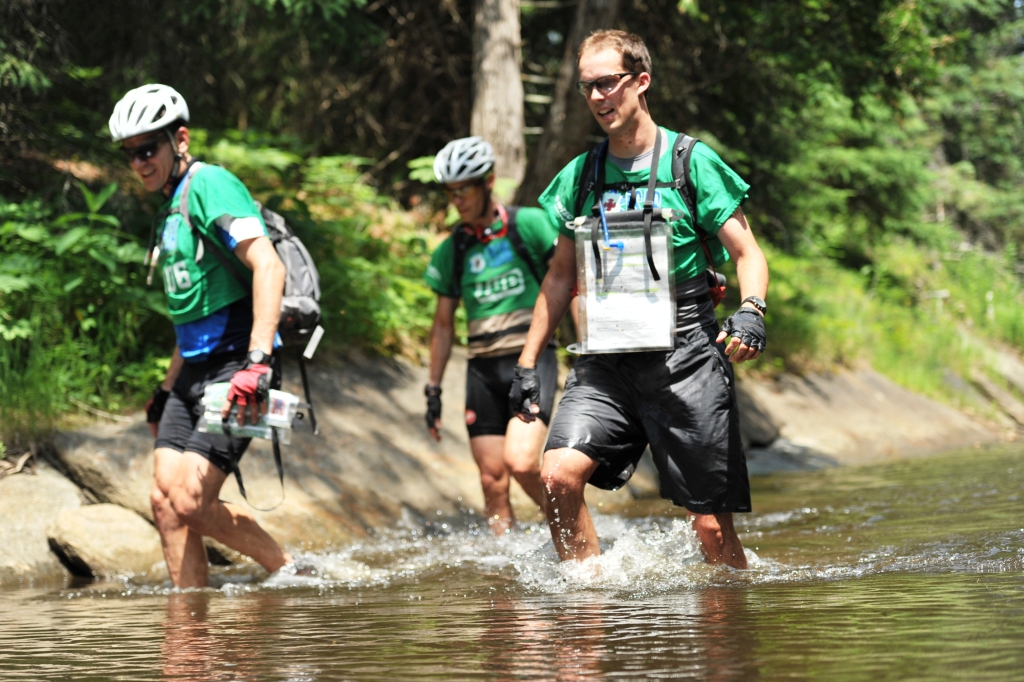
Heath mentioned that the emerging popularity of obstacle course races might cause a resurgence of participants in adventure racing as this could be the next step for someone after doing an event like Tough Mudder. Jonathan Gascho, a fourth-year business student at Wilfrid Laurier University and member of the Golden Hawks cross-country team, did Tough Mudder and World’s Toughest Mudder last year. “It’s a challenge that you don’t normally put yourself through and you just want to see if you’re capable of completing it. And then once you know that you’re capable of completing it, it’s how much better can I get,” Gascho said of the elevated challenge of obstacle courses.
He is considering participating in an adventure race in Pennsylvania next year. “The best way to get involved with the sport is either to volunteer with an event … or come out to some of the clinics,” Miller explained. He also recommended just grabbing some friends and trying out an entry-level race. “Give it a shot,” Roper encouraged. “If any of those elements — paddling, mountain biking, trail running, navigation, team work — are at all appealing to you, by all means give it a shot because it’s much more achievable than you might think.”
In closing, Heath imparted a theory she and other racers have formed. “I think you can learn a lot of useful life skills,” she said. “Like whenever I am confronted with a problem it’s compared to: hey, remember that time I was stuck on that mountain? Or, remember that time I trekked for forty hours and my feet were raw? I’d like to say adventure racing has made me a better human being.”




Leave a Reply
You must be logged in to post a comment.