From Campus Pitch to National Stage: Verdanza’s Mission to Reduce Food Waste
A student pitch competition, here at Laurier, has grown into a nationally recognized sustainability startup, as Verdanza, a student-led venture incubated through Laurier Changemakers, works to address food waste through technology, education and packaging innovation.
Founded by Urvi Budhiraja and Helen Sue, Verdanza began two years ago as an idea presented at a Changemakers pitch competition. The concept, which focused on reducing household food waste through behaviour change, placed first, pushing the founders to turn the proposal into a working enterprise.
“We both had experiences where we’d seen people not able to get enough food, while at the same time so much food was being wasted,” Budhiraja said in an interview. “Food waste is a huge blind spot, and we wanted to see if there was a way to actually change behaviour around it.”
Following the competition, the team sought mentorship through Laurier Changemakers, an on-campus incubator that supports student-led social and environmental initiatives. With guidance from Laura Allen, faculty advisor for Laurier Changemakers and assistant professor in the Lazaridis School of Business and Economics, Verdanza transitioned from an early-stage idea into an active startup, gradually expanding its team and refining its focus.
Verdanza has since grown to include more than 15 students working across technology, research and outreach. Budhiraja said the incubation process required consistent effort from both sides.
“It was a two-way road,” she said. “We put in the work, and Changemakers provided us with mentorship and direction on how to actually move forward.”
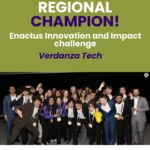
As part of that process, Verdanza entered Enactus, a national social entrepreneurship competition that challenges student teams to develop ventures with measurable social impact. The team won the Central Canada regional competition and went on to compete at the national level, finishing as a finalist.
Presenting on the national stage was a major milestone, Budhiraja said, and forced the team to clearly articulate what differentiated Verdanza from other food-waste solutions already on the market.
That question, she said, also represented one of the startup’s biggest challenges. Early on, the founders realized that similar apps and initiatives already existed, prompting them to reassess their approach.
“We had to step back and really look at our competition,” Budhiraja said. “We asked ourselves, what gaps are still there, and how can we cover them?”
Sue said that reflection helped shape Verdanza’s current model, which is built around three core components rather than a single solution.
“At the centre of Verdanza is stopping food waste, but we didn’t want to focus on just one thing,” she said.
One pillar of the startup is an AI-based application designed to help households reduce food waste by encouraging better habits around purchasing, storage and consumption. The app is currently live, and the team is focused on increasing user adoption and gathering feedback to improve its effectiveness.
Another component is an educational program aimed at children. Sue said research shows behavioural patterns begin forming early, making youth education a key part of long-term change.
“We want to start that awareness at a very early stage,” she said. “So, in the future, they can be part of reducing food waste, not just reacting to it.”
Verdanza is exploring partnerships with local school boards to deliver workshops and educational programming, extending its reach beyond the university campus.
The third element of the project is still in development: an alternative to traditional “best before” labels. Budhiraja said confusion around food labelling leads many consumers to discard food that is still safe to eat.
“Best before dates aren’t standardized, and people don’t really understand what they mean,” she said. “There’s this assumption that food is unsafe, even when it isn’t.”
The team is researching a potential edible label that changes colour based on food freshness, with the goal of providing clearer, real-time information to consumers.
Verdanza recently received $5,000 from Laurier’s Sustainability Hawk Fund, which the founders plan to use to host campus events, expand outreach and build awareness around food waste. They have already participated in events such as International Food Fest and on-campus booths to engage students in sustainability discussions.
Looking ahead, the founders say the focus is on scaling the app, expanding educational partnerships and continuing to test new ideas through competitions and funding opportunities.
For Sue, the experience has reinforced the value of taking risks. “If you have an idea, just go for it,” she said. “Even if it fails, it can always be improved or lead you somewhere else.”
Budhiraja echoed that sentiment, saying Verdanza has pushed her beyond her comfort zone and reshaped how she thinks about ambition.
“Turning ambition into action takes patience, hard work and belief,” she said. “Even a small idea can change more than you expect.”
Verdanza is currently seeking volunteers, particularly students interested in technology and marketing, to support its next phase of growth.
Contributed Photo/Verdanza Laurier