

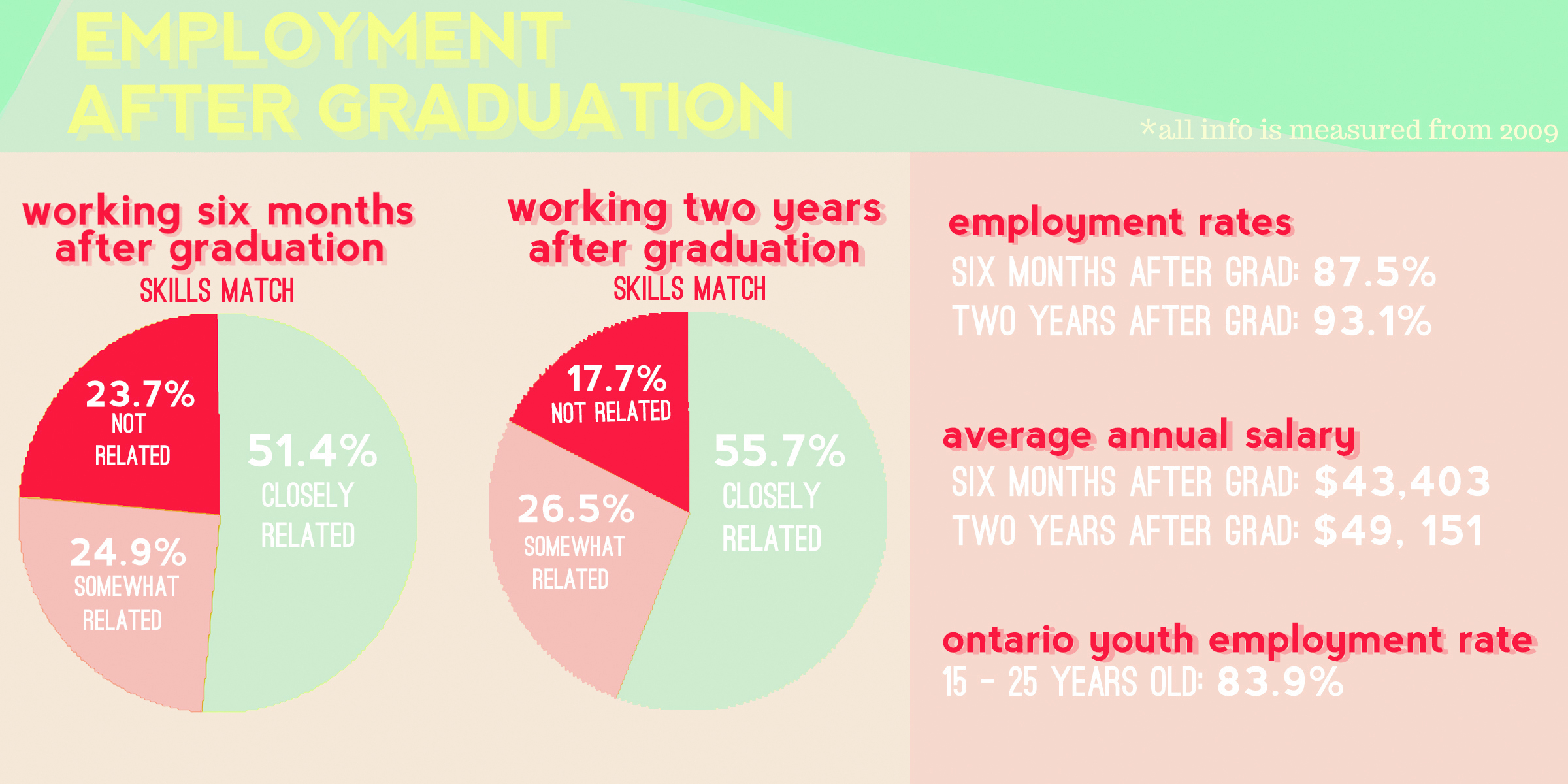
Contrary to the popular rhetoric that university graduates are emerging from their degrees with minimal job prospects and no means of paying down their debt, a survey released this past fall indicated that Ontario university graduates fared reasonably well in spite of the recession.
Titled Employment Outcomes of 2009 Graduates of Ontario University Undergraduate Programs, the report was put forth by the Council of Ontario Universities (COU).
The report showed data for 2009, with comparisons also available for several previous years of data. Although decreases were seen in all four categories – employment rates, Ontario youth employment rate, skill match and average annual salary – the changes were not significant in the latter two categories.
“It wasn’t a significant drop, but something that we have to pay attention to,” said Bonnie Patterson, the CEO and president of COU. “I’m very conscious of the fact that 2008 was the height of the recession and 2009 we were coming out of it, that we hadn’t started to see pick-up in GDP or other indicators, more broadly speaking, in the economy. My sense is that we may well see the next survey suggest something more positive.”
Zach Dayler, the national director of the Canadian Alliance of Student Associations (CASA), added, “There’s no disputing the fact that there’s a narrative out there that young people aren’t doing well after they graduate, because the jobs aren’t there, and I don’t think that we can say that that’s wrong. I think what we’re curious about it maybe that the scale of what we thought this problem wasn’t as large as it actually is reported.”
Data in the skills match category showed that six months post-graduation, 51.4 per cent of Ontario university graduates were employed in areas they considered “closely” related to their university education according to 2009 statistics. Patterson said that although comparative data is not available for five years after graduation, information from institutional alumni surveys indicates that the percentage of students working in fields not related to their degrees continues to lower.
“Once you get experience behind you and start moving into other opportunities, you obviously use that experience and your educational background to a better advantage,” she said.
Dayler acknowledged that this might involve students using skills they’ve learned in university, not necessarily in fields that are directly related to their degree.
“There’s a value to going and pursuing a post-secondary education which is the critical thinking aspect … Being able to apply all the skills you learn to a wide variety of disciplines,” he considered.
However, while employment earnings may bode well for graduates, with the average annual salary at $42, 403 in 2009 for graduates six months out of their degrees, according to Dayler, this may not wholly reflect post-grad challenges.
“From the concern of students, it really comes down to what is the debt load and what’s that preventing them from doing? It’s positive that they’re working, we’re going to need to have more people working, but also … we need more educated people with less debt. We also need more employed people with less debt,” Dayler explained.
Patterson and Dayler also situated the survey within the context of a changing work force.
“There’s no question there’s a skills shortage that is emerging. As the job market restructures and we move more into a knowledge-based economy … we do see that professional and management occupations by far outweigh the growth in jobs over other types of jobs,” said Patterson.
“People are only going to be able to find hopefully more jobs as the baby boomers retire, but then the problem becomes we don’t necessarily have the work force to meet the demands of that retiring population,” added Dayler.




Leave a Reply
You must be logged in to post a comment.