
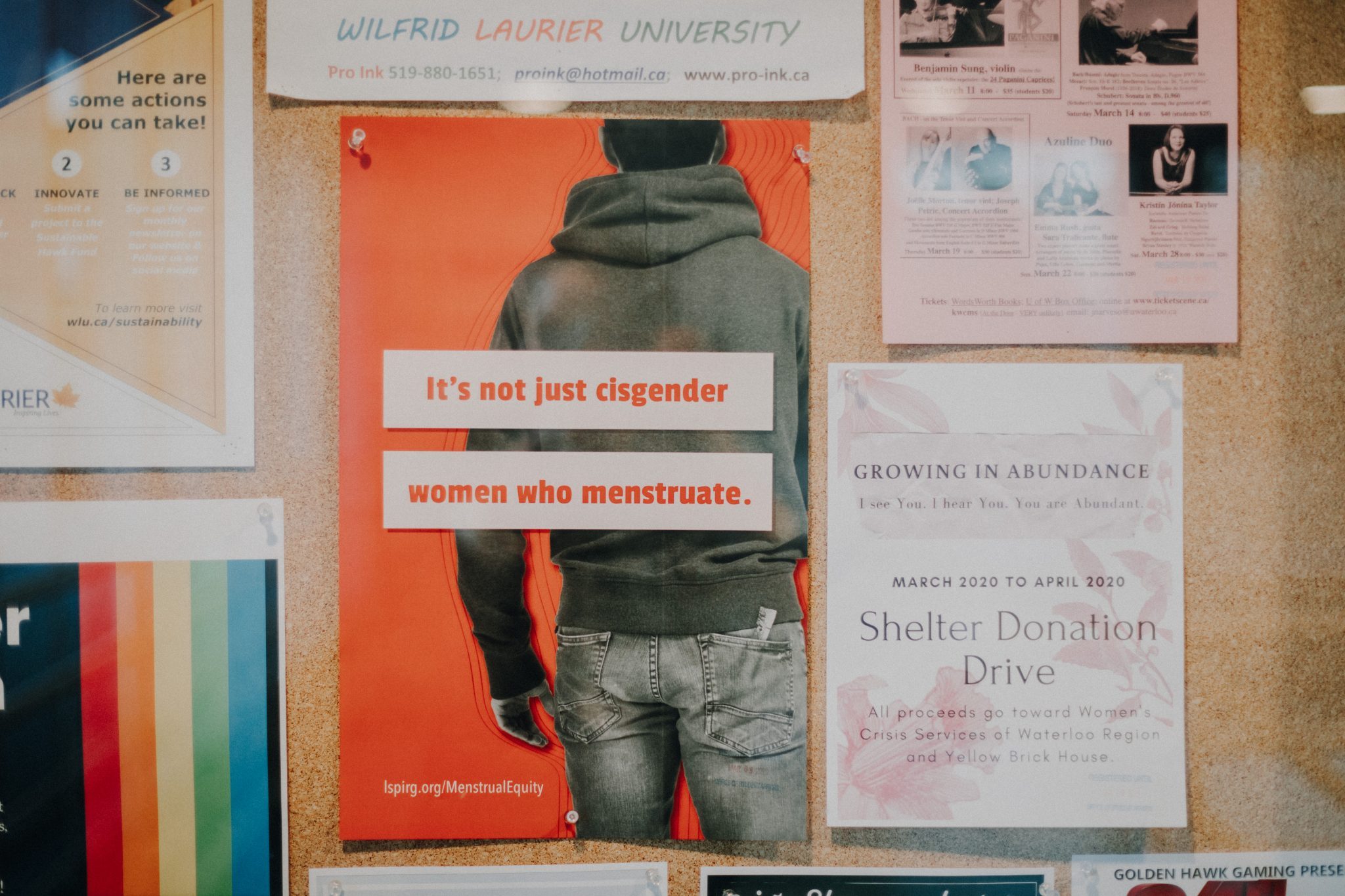

For a campaign promoting menstrual equity and education on Wilfrid Laurier’s Waterloo campus, a series of posters with black-and-white images of period blood-stained underwear have sparked noteworthy controversy and debate online.
The posters include a series of messages, such as “ain’t no shame in menstruating,” as well as other promotional sayings that are working to dismantle the belief that only cisgender women menstruate and that a portion of students don’t have adequate access to menstrual hygiene products.
On Reddit, users have shared their distaste with this postering method by directing their criticisms towards Laurier Students’ Public Interest Research Group (LSPIRG).
“Posting disgusting images of underwear in Lazaridis Hall too. Not sure how this is allowed. They can post it in the gender studies class all they want, outside of that, it’s just gross,” remarked one commenter in the thread.
Hayley Newman-Petryshen, LSPIRG member, and chair of Wilfrid Laurier University’s Menstrual Equity Committee, is working to deconstruct the misconceptions that have been circulating around the posters, and by extension, menstruators themselves.
“We did anticipate some controversy around it and it’s all part of the education process,” Newman-Petryshen said.
And while there seemed to be the belief amongst some students that LSPIRG was spending money on the campaign, that isn’t the case.
There’s a reason that food banks provide menstrual care products, and that’s because people genuinely do have to choose between whether [they] can buy a box of tampons or a box of cereal. And that’s just a gendered barrier that I don’t think should exist.
– Hayley Newman-Petryshen, member of LSPIRG and chair of WLU’s Menstrual Equity Committee
“A lot of the controversy appeared to be around how LSPIRG is funded, and I think in terms of misinformation, one thing is that LSPIRG has put zero dollars into this campaign. I volunteer with [LSPIRG] and they have been supportive of this campaign, and instead of us having to buy a whole new website domain, they have agreed to host the educational part on their website, at no extra cost for us which has been great, but we are not at all exclusively affiliated [with them],” Newman-Petryshen said.
“The campaign is basically the work of the Menstrual Equity committee, which I started and includes the Students’ Union, Sustainability Office, Office of Dispute Resolution and Sexual Violence Support … there [are] so many collaborators.”
“All of the funding has come from the Student Life Levy and the Sustainable Hawk Fund, and not a single penny has come from LSPIRG — they’ve just been generous enough to donate their website and volunteer resources for it,” she said.
And while the images on some of the posters have been criticized for being too “graphic,” according to Newman-Petryshen, this was a design choice that was purposefully implemented in order to open up more conversations about the public perceptions of menstruation.
“If you think about horror movies, there’s never any controversy, for the most part [about seeing blood]. But the moment it’s menstrual blood, everyone is like ‘no thank you, that is too much.’ So we picked that image intentionally,” Newman-Petryshen said.
“We made it black-and-white because we wanted to tame it a tiny bit. We just wanted to de-stigmatize this idea that menstrual blood should be hidden.”
There are also students on campus who don’t have proper access to the period products that they need, and some are faced with making difficult decisions about whether or not they can afford them at all.
If someone who menstruates is caught short on campus, there are currently no sanitary options available in washrooms — even coin-operated dispensers.
The cost of buying a whole box of pads or tampons from a store can be high for some people, and it creates what Newman-Petryshen believes is a noticeable issue that should be addressed.
“There’s a reason that food banks provide menstrual care products, and that’s because people genuinely do have to choose between whether [they] can buy a box of tampons or a box of cereal. And that’s just a gendered barrier that I don’t think should exist,” Newman-Petryshen said.
“It’s behind this whole idea that if you’re getting toilet paper for free, soap is free [and] paper towels are free, then there’s no reason that pads and tampons should not also be free.”






Leave a Reply
You must be logged in to post a comment.