

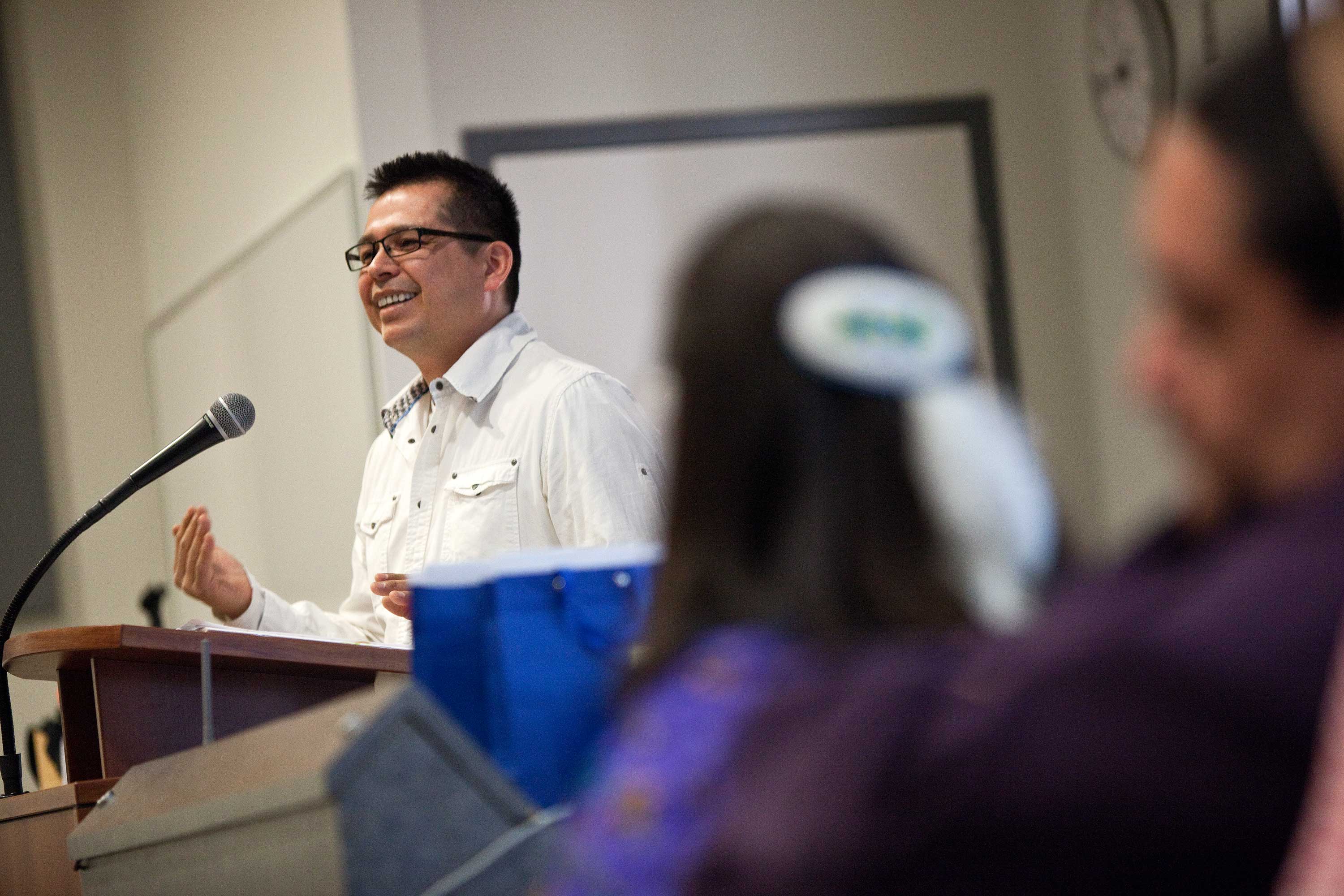
One of the major events of Aboriginal Awareness Week last week was “Your Earth, My Earth, Your Water, My Water,” a panel discussion about the implications of Bill C-45 on the environment and the well being of Aboriginals living in Canada. The bill has sparked a large reaction in the form of protests, which eventually resulted in the Idle No More movement.
The panel discussion was the second last event of the week on March 9 and featured Kathy Absolon-King, Jode Kechego, Awasis Sakihtowis, Darren Thomas and Sheri Longboat. This Aboriginal Awareness Week, which was the third installment at Laurier, was aimed at getting students, community members and faculty thinking about Aboriginal issues and culture.
The talk began with a traditional drum song and singing by some of those that were involved throughout the week, and a water ceremony, which was given by Absolon-King, program coordinator for the Aboriginal field of study.
“It’s something that I think we take for granted, it’s something that we don’t really have to think about because we don’t have to. But without water we wouldn’t be alive,” explained Absolon-King while she was addressing the crowd Saturday in Bricker Academic Building.
“Everything we need in terms of medicine and food comes from water,” she added.
Since the talk was centered on the Idle No More movement and the current relationship between Aboriginal groups and the federal government, Absolon-King’s ceremony had a bit of a political tone to it.
“If you have voice, if you have a means — whatever that is — use it. Maybe we should put those politicians on a fast, so they could appreciate water,” she continued. “They probably wouldn’t be able to handle going on fast. Maybe they would take another look at what they are doing.”
The moderater of the discussion was Jode Kechego, senior policy analyst advisor for Anishinabek Nation, as well as a writer on Aboriginal issues in Canada. He urged the crowd to think differently about how Idle No More is portrayed in the mainstream media.
“Too often First Nations people are seen as either passive or submissive, historically and today. That passiveness and misinterpretation is a misguided view of who First Nations people are,” he asserted.
“Western society feels the need to control things,” he added, giving his reason to why the federal government has introduced some of the legislature that sparked the Idle No More movement.
In addition to the panel discussion, there were interactive workshops and other speakers throughout the week.
“I think it went well, we did the event [at] both Brantford and Waterloo and had some events in Kitchener as well. We really incorporated a multi-campus approach to Aboriginal Awareness Week,” explained Melissa Ireland, Aboriginal student support coordinator for the Waterloo campus.
“One of the things that we did for Awareness Week was incorporate some of our existing programs already in the week to show the university that they are welcome to come out to pre existing events,” she said.
“The week was very thoughtful and engaging.”





Leave a Reply
You must be logged in to post a comment.