

On Feb. 3, the Waterloo Regional Police Service charged five impaired drivers in the span of six hours in Cambridge. Following the incidences, questions have been raised about whether drinking and driving is a rising issue in Waterloo Region.
“Although we have a large amount of people who are compliant and understand the risks of impaired driving, there are still unfortunately a small amount of people who make bad decisions and choose to drink and drive,” said Olaf Heinzel, public affairs coordinator for WRPS.
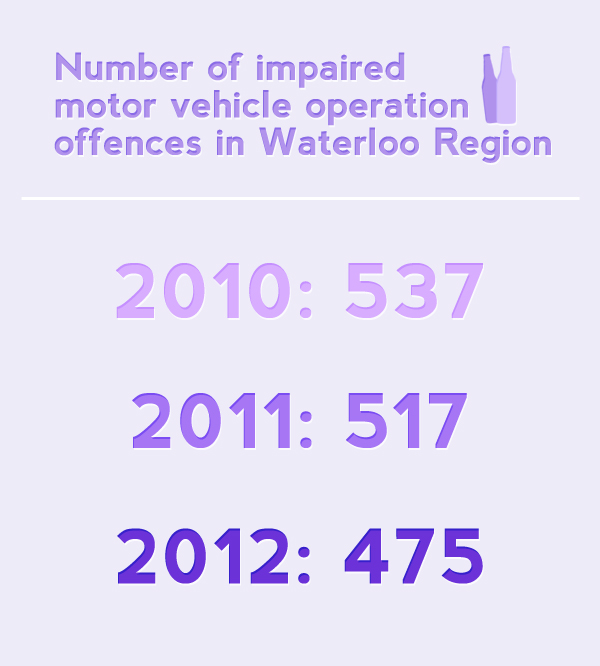
While the official number of drunk driving cases is unavailable for 2013, in 2012 there was a reported 475 cases of drunk driving in Waterloo Region. In 2011, that number was 517, and 537 in 2010.
Heinzel said that while the statistics shows a decline, the problem is still out there.
“The statistics can vary for a number of reasons, the main one being that fewer people are actually drinking and driving. But also the type and length of enforcement from one year to the next varies and the RIDE program might also vary in terms of how many days we go out for.”
Although the statistics shows a decline in the amount of drunk driving cases in Kitchener-Waterloo, organizations within the community still see it as a concern.
“You can’t really say it’s on the rise or that it’s going down. In all honesty, it’s staying the same. It varies from month-to-month,” said Jolene Knott, vice president for the Waterloo chapter of Mothers Against Drunk Driving (MADD).
Knott also pointed out that when talking about drunk driving, there needs to be consideration towards drug impairment as well.
“We need to also consider drug impairment when we talk about driving impaired, because people also take drugs and drive just as they drink and drive.”
Looking at the causes of drunk driving, Knott believes it comes from people not thinking ahead.
“People aren’t planning ahead; I think that is a very big one. They think they will only have one drink and they end up staying for most of the night and getting smashed, and end up not wanting to leave their car at the restaurant.”
Knott thinks that people undermining the risk of drinking and driving is another problem.
“Also people don’t think it’s a risk, they think they are okay to drive. They don’t realize they are impaired, or how impaired they are, which unfortunately is the more accurate statement in all honesty. You sometimes hear people say they drive better then they are drunk, when in fact that is completely false,” said Knott.
Preventing drunk driving comes down to the importance of public awareness.
“Public awareness is what makes all the difference. If the public is aware of the risks associated, reasonable people will make the right decisions,” said Heinzel.
“You want to catch it before it happens. The more aware the public is, the less likely they are to get behind a vehicle impaired,” said Knott.
Teaching the public about the consequences of the impact of drinking when driving is also key, Heinzel believes.
“It’s a question of keeping the public informed about the risks associated with it … It’s about reinforcing the message that it is unacceptable to drink and drive or to consume an impairing product while driving,” said Heinzel.






Leave a Reply
You must be logged in to post a comment.